TL;DR
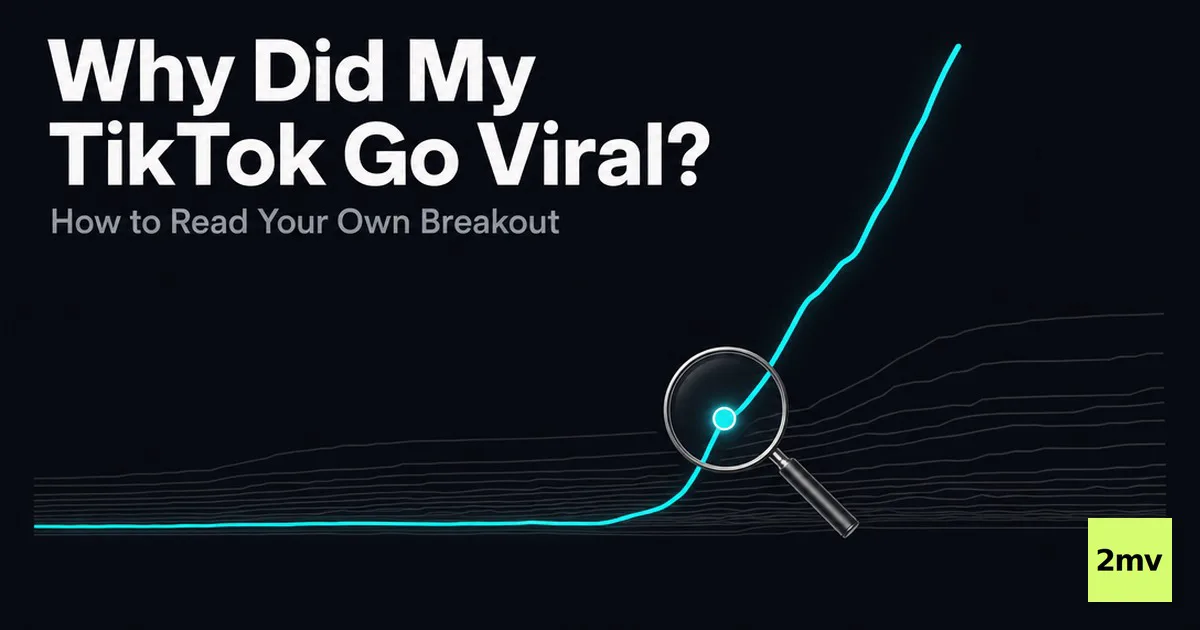
- The honest answer to "why did my TikTok go viral" lives in your own analytics: within 48 hours you can identify which traffic source carried it, who watched, how long they stayed, what commenters say the hook was — and how much of the breakout remains, legitimately, luck.
- Capture the evidence first — the views curve, the traffic source mix, the watch-time metrics, the comments — because the live picture becomes harder to read every day after the spike.
- Then run a diff against your account's normal: which one thing about this video was different, and which several things stacked on top of each other?
- For videos that never took off, the retention graph tells you where viewers left, and the fix depends on whether the exit happens in the first three seconds or in the middle.
- A diagnosed breakout converts into a template and scheduled variants; an undiagnosed one converts into a screenshot you scroll past next month.
1. A Breakout Is a Dataset Before It Is a Celebration
A viral video on your own account is the highest-quality research material you will ever get, and the window for reading it properly is short. The view counter climbs for days, but the signals that explain the climb — the traffic source mix, the shape of the audience, the exact words viewers use in comments — are most legible in the first two days. Most creators let it close: they screenshot the view count, post a thank-you, and return to guessing. That is an expensive habit, because the breakout is the one experiment where every input was yours and every datapoint is first-party.
It is also a different job from breaking down other people's videos. Our frame-by-frame guide to analyzing a viral video covers the method for studying anyone's winner when you have only the video itself; your own breakout hands you three extra sources no outside analyst gets — full analytics, your publishing history as a control group, and a comment panel talking directly about your work. Reading your own event means using all three, in order, before the evidence decays.
This article gives you the sequence: a capture checklist for the 48 hours after the spike, a diff method for isolating which variable actually changed, a triage for the videos that did not break out (the flop and the hit are read with the same tools), and the conversion step that turns one diagnosed hit into a template you can schedule against. One warning before the mechanics: part of every breakout is distribution luck, and the honest goal of this work is to shrink the unexplained share of the outcome, not to pretend it reaches zero.
2. The First 48 Hours: Capture the Evidence While It Is Legible
Start by saving the data, not interpreting it — exports are free today and impossible two weeks from now when you finally ask what happened. TikTok's analytics for an individual video include the view trend, traffic source breakdown, watch-time metrics, audience information, and comments, and every one is more useful frozen at a timestamp than recalled from memory. Five artifacts, saved in order, make up the complete evidence kit.
- The views curve. Export or screenshot views over time and write down the hour the climb started. Whether the video re-accelerated after a plateau is information the lifetime total destroys.
- The traffic source mix. Per TikTok's analytics documentation, the source types as of September 2026 are the For You feed, your profile, the Following feed, search, sounds, and hashtags. Save the split exactly as shown.
- The watch-time pair. Capture "average watch time" (how long the typical viewer stayed) and "watched full video" (the share of viewers who reached the end).
- The audience split. Where your analytics version shows it, record the follower versus non-follower view split plus the top territories.
- The comments. Copy or export the top fifty before you reply to anyone, so the record stays clean of your own prompts.
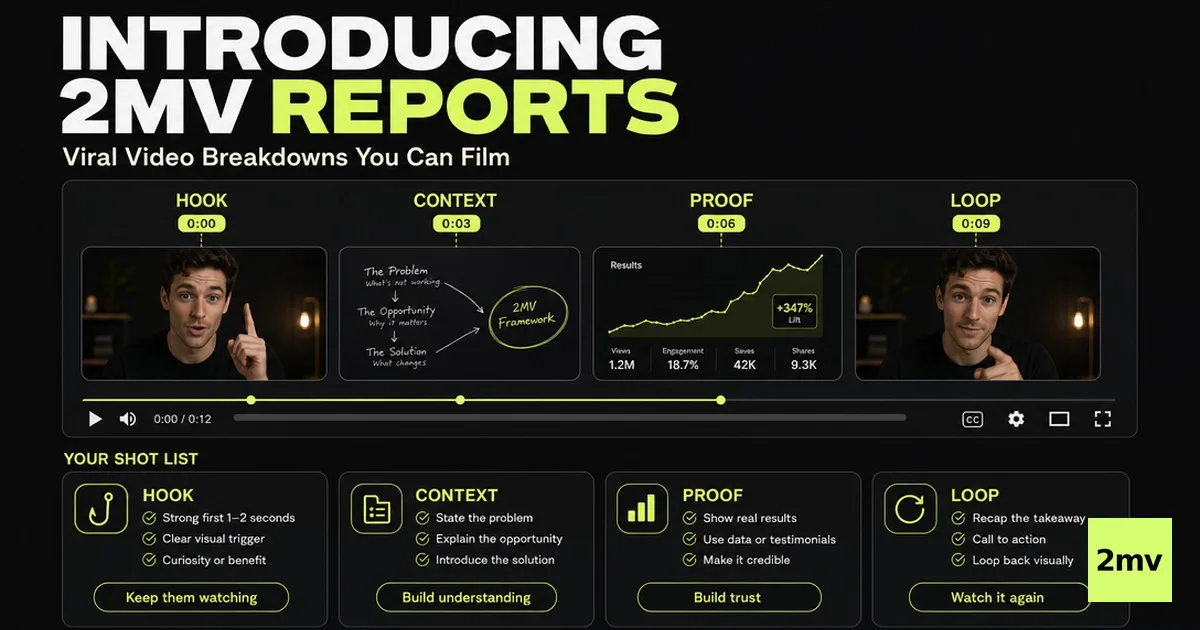
Why save rather than glance? Every diagnosis in the next sections is a comparison — this source mix against your account's normal, this watch-time pair against your other uploads — and comparison needs stored numbers, not impressions. Daily tracking matters for the same reason; our introduction to 2mv Reports covers what daily monitoring adds after the spike fades.
Once the evidence is saved, the source mix does its real work: it classifies the breakout. A video carried overwhelmingly by For You was pushed by TikTok's recommendation system into a broad interest pool; a heavy profile share means viewers liked the clip enough to check who you are; a visible search share means the video answers a query people type — slower traffic that also decays slower; heavy sound or hashtag shares mean the video rode a vehicle many others are riding the same week. The table is the reading guide.
| Dominant source | Breakout type | What it says happened |
|---|---|---|
| For You feed | Recommendation-driven | The feed found a large interest pool that matched the video |
| Profile | Identity-driven | The video converted viewers into profile visitors, often mid-binge |
| Search | Query-driven | The video answers something people type; traffic compounds and decays slowly |
| Sound / hashtag | Trend-driven | A shared vehicle delivered viewers who were browsing that vehicle |
No single line of that table is the answer on its own; what it gives you is the breakout's type, and type matters because the four kinds repeat under different conditions. Cross-check the type against the comments: group the top fifty into three to five themes and look for the beat viewers keep naming — "I came for the recipe and stayed for the story." High watched-full-video plus comments clustered on one moment marks the asset you will extract in section 5; recurring questions mark the beat where viewers got lost.
3. Isolating the Real Variable: Diff the Video Against Your Own Baseline
The question that produces answers is not "why did this video work?" but "what was different about this video, relative to everything else I have published?" That reframe turns tribute into a diff, and a diff has a method: establish the baseline, compare dimension by dimension, and refuse to crown a single winner until the evidence supports it.
First build the baseline: open your last twenty or thirty uploads and write down what is normal — typical hook device, usual sound choices (trending versus original audio), usual posting window, usual subject, typical length and format. It need not be scientific; it needs to be written down, because memory will insist the breakout was "basically like everything else," which is almost never true.
Then diff the breakout against that baseline, marking which of these candidate variables actually differ for this video:
- Hook device — did the first two seconds use a device you have never used (motion-first, a question overlay, a bold on-screen claim), or your usual opener?
- Sound — an original or trending track outside your normal choice, or the same kind of audio you always use?
- Posting window — a materially different time or day than your habit?
- Topic pool — did the subject step out of your niche into a much larger interest pool (a general-life topic inside a specialist account, for example)?
- Format and length — something structurally new: a talking-head account that posted a demo, a 15-second format stretched to 60?
Here most post-mortems go wrong: they find one differing variable and declare it the cause — "it was the sound." Treat every single-variable claim as a hypothesis and check it against the source mix from section 2: if the sound-page share is negligible, the sound theory dies in one glance. In practice breakouts involve stacking — a new hook on a larger topic pool with a sound people were already seeking out, published while the pool was active — and the diff tells you which variables stacked, rarely handing you one culprit.
Honesty requires one more step: even a complete diff leaves a residue you cannot attribute. Which test audience the video drew first, what larger creators published the same week, plain distribution timing — all real factors, none visible in any dashboard; the small-audience testing that precedes a wider push is commonly understood, though not officially specified, as of September 2026. Say it plainly in your notes: the diff shrinks the unknown, it does not eliminate it — anyone claiming to fully explain a breakout after the fact is selling certainty the data does not contain.
The diff is also where naming things precisely pays. "Better hook" is a feeling; "motion-first hook — the object enters frame before anyone speaks, question overlaid by the second second" is a device you can reuse on purpose. Frame-level decoding is the fastest way to get there, and an AI video analyzer runs it on your own link in minutes when you would rather spend the afternoon shooting than scrubbing.
4. Diagnosing the Videos That Did Not Take Off
The flopped video and the viral one are read with the same analytics, and the flop's story is almost always told by a single graph: retention. Creators ask "why is my tiktok not going viral" as if it were one question, but it is at least four — the video failed to hold the viewers it got, the video held them but reached too few, the hook worked and the middle lost them, or the account has not published enough for the question to have an answer. The retention graph, read together with the source mix, separates them in minutes.
Locate the drop-off first, because the fix depends entirely on where viewers leave. Loss concentrated in the first three seconds is a hook failure — the video never earned its chance, no matter what is in the middle. Loss starting later, in the first third, usually means the hook made a promise the pacing did not honor: a dead beat, an over-explanation, a payoff endlessly deferred. A steady, gentle decline to the end is not a retention problem at all — it is the natural shape of a decent video, and it redirects attention to the source mix: the video held the viewers it reached, and it reached too few of them.
With the drop-off located, work the diagnosis in priority order, because each level is cheaper to fix than the one below it:
- Retention shape — first three seconds, middle, or gentle slope: it decides whether you are fixing a hook, a structure, or nothing at all.
- Source mix — did the video reach any non-follower pool, or mostly your existing followers? A good-retention video shown only to followers has a distribution question, not a content question.
- Hook diff — apply the section 3 method in reverse: what does your winner do in the first two seconds that this video does not?
- Topic pool size — is the subject something only fifty people care about this week? Small pools produce good videos with small results.
- Sample size — "why do my tiktoks never go viral" is a pattern claim, and pattern claims need more than five videos of evidence. Publish on a cadence long enough for the diagnosis to have something to work with.
Two cautions keep the triage honest. Fix the top of the list before the bottom — topic replanning is wasted effort when viewers leave in the first second, and the cheapest experiments (hook swaps, beat cuts) come out of tonight's editing session. And when the diagnosis ends at "good video, small pool," do not write the video off; it is a candidate for the re-trigger mechanics in the next section.
5. Converting One Breakout into a Reusable Asset
A diagnosed breakout becomes an asset through three steps — extract, template, vary — plus an understanding of how old videos earn second lives. Extraction means writing the winner's structure in lines that never mention its subject: the hook device in one sentence, the beat count and where the payoff lands, what the closer does (loop back, deliver the reveal, ask the question). The template is the invariant skeleton underneath the content, and writing it separates teams that repeat success from teams that reminisce.
Variants are the template put back to work: reshoot the same skeleton with a different subject, object, or sound — hook device identical, beats identical, content new. One breakout becomes a scheduled series, and each variant doubles as a test of which stacked variable was causal: if the skeleton keeps performing with new subjects, the structure was the asset; if every variant flops, the original rode timing or luck the template cannot reproduce. Either result is knowledge. When this extraction needs to run across dozens of niche videos rather than one, that is the volume where an AI video analyzer absorbs the scanning while you keep the judgment calls.
The other half of conversion is the second life, because "can my tiktok go viral later" has a real answer: yes, through mechanisms you can partially influence. Search keeps delivering viewers to videos that answer typed queries, weeks after the recommendation push ends; sound pages keep routing browsers; and recommendation systems are commonly understood, as of September 2026, to re-test older content when an account's momentum changes — which is why a months-old video occasionally detonates the week newer content performs. None of it can be commanded, but the door stays open when the video stays public, fresh comments get replies (engagement is a live signal), a pinned comment restates the hook, and the caption carries the keywords searchers actually type.
Timing closes the loop: schedule the variants while the pool is warm. A template executed two months later competes in a different distribution environment, and teams that wait for "the next content day" often find the topic has cooled. The week after a breakout — diagnosis written, template extracted — is when the follow-ups should already be on the calendar.
6. What to Watch Out For: Three Misreadings That Waste a Breakout
The three most expensive ways to misread a viral hit share a shape: they let a flattering explanation replace the diagnostic work. Each has a specific tell in the section 2 data.
The first is crediting a platform event to your own skill. Trending sounds, hashtag waves, and seasonal surges put your video in front of people browsing the vehicle, not searching for you — and the tell sits in your source mix. If sound and hashtag shares dominate, the vehicle did much of the carrying, and the honest conclusion is that you picked the right vehicle at the right time: a real skill, but a different one from making a video that carries itself. Get this wrong and you will template the wrong structure, then wonder why the faithful reproduction flops.
The second is generalizing from a single breakout — treating one outlier as the new normal. One data point is a hypothesis; the variant series from section 5 is the experiment that promotes or kills it. Teams that skip it answer "why did only one of my tiktoks go viral" with a story instead of a diff. The related trap is totals over ratios: a million views with a two-second average watch time is weaker evidence than fifty thousand watched to the end, because totals measure reach while ratios measure whether the video deserved it. Where absolute view counts sit in that picture — platform thresholds, payout ranges, and why the numbers you see quoted conflict — is its own question, covered in how many views it takes to go viral.
The third is the delete-and-repost reflex: scrapping a video that "underperformed" and re-uploading a near-identical version for a fresh roll of the dice. Identical re-uploads risk duplicate-content treatment, whatever signals the original accumulated reset to zero, and the fifteen-minute retention diagnosis from section 4 usually shows the fix lives inside the video — a first-second rework or a cut middle — not in a second coin flip. Fix forward with a variant; keep the history. One boundary note: if you run a single hobby account publishing a handful of videos a month, every diagnostic above runs fine on TikTok's free native analytics alone — added tooling buys speed there, not capability.
7. Conclusion
Your breakout already contains its own explanation, in decreasing order of certainty: the source mix says why it spread, the watch-time pair and the comment clusters say what held, the diff against your baseline says what changed, and a stubborn residue says — accurately — that luck was a co-author. Capture in the first 48 hours, diagnose in the first week, template and schedule the variants while the pool is still warm, and give the flops the same fifteen-minute triage before you delete anything. Do that consistently and hits stop being weather reports and start being data points in a system. 2mv Studio is built to run that system — the monitoring, decoding, and playbook layers assembled for you; start for free and bring it your last breakout as the first case file. It will not promise you the next one. It makes sure the next one never happens without you knowing why.
FAQ
Should I delete and repost a flopped video?
Usually no — diagnose and fix forward with a variant instead. Identical re-uploads risk duplicate-content treatment, the original's accumulated signals reset to zero, and the retention graph will show you the real problem (a first-three-seconds failure or a dead middle) that a repost does not solve. Deletion is for content that is wrong, embarrassing, or a privacy problem, not for content that underperformed.
Can my TikTok go viral later, after it has been posted for weeks?
Yes, and two mechanisms make it happen. Search traffic keeps arriving for videos that answer typed queries, and recommendation systems are commonly understood to re-test older content when an account's momentum changes — as of September 2026 neither mechanism is officially specified. Keep the video public, reply to fresh comments, and carry searchable keywords in the caption; none of it commands a second wave, all of it keeps the door open.
Can a TikTok go viral overnight with no followers?
Yes — distribution on TikTok runs on how a video performs with the test audiences it is shown to, not primarily on follower count, which is why brand-new accounts sometimes outperform established ones. "Overnight" is really a compressed version of the 48-hour diagnostic: capture the source mix and comments immediately, because a no-follower breakout is almost pure recommendation traffic and the evidence decays just as fast.
Why did only one of my TikToks go viral?
Because a breakout requires several variables to align at the same time — hook device, topic pool, sound, timing, plus a luck residual — and your other videos were each missing at least one alignment. Run the diff from section 3 across all of them: the columns where the outlier differs from the rest are your candidate variables, and the variant series in section 5 is the experiment that tells you which candidate was actually causal.
What happens when you go viral on TikTok — what is the first thing to do?
Save the evidence before you celebrate: export or screenshot the analytics, copy the top comments, and note the hour the climb started, all within 48 hours. Then work the checklist — source mix, watch-time pair, audience split, comment themes — because the views will take care of themselves while the diagnosis only gets harder to reconstruct. Pinning a comment that restates the hook and replying to new ones converts some of the traffic into profile visits while it lasts.
Why is my TikTok not going viral when I copy my own viral video exactly?
Because the variables that made the original work include timing, topic-pool temperature, and a luck residual, and none of them travel with the footage. The copy is tested as a new video in a different week, so compare the two retention graphs before concluding the concept expired: if the copy dies in the first three seconds, the execution drifted from the template; if it holds viewers but reaches few, the pool or the moment changed, not the idea.
Why did my TikTok go viral · published 2026-09-14 · 2mv Team