How to Know If You Are Shadowbanned on TikTok
TikTok does not provide a button labeled “shadowban status.” It does provide something more specific: account restrictions, post-level For You eligibility decisions and notices when repeated ineligible content makes an account harder to recommend or find in search.
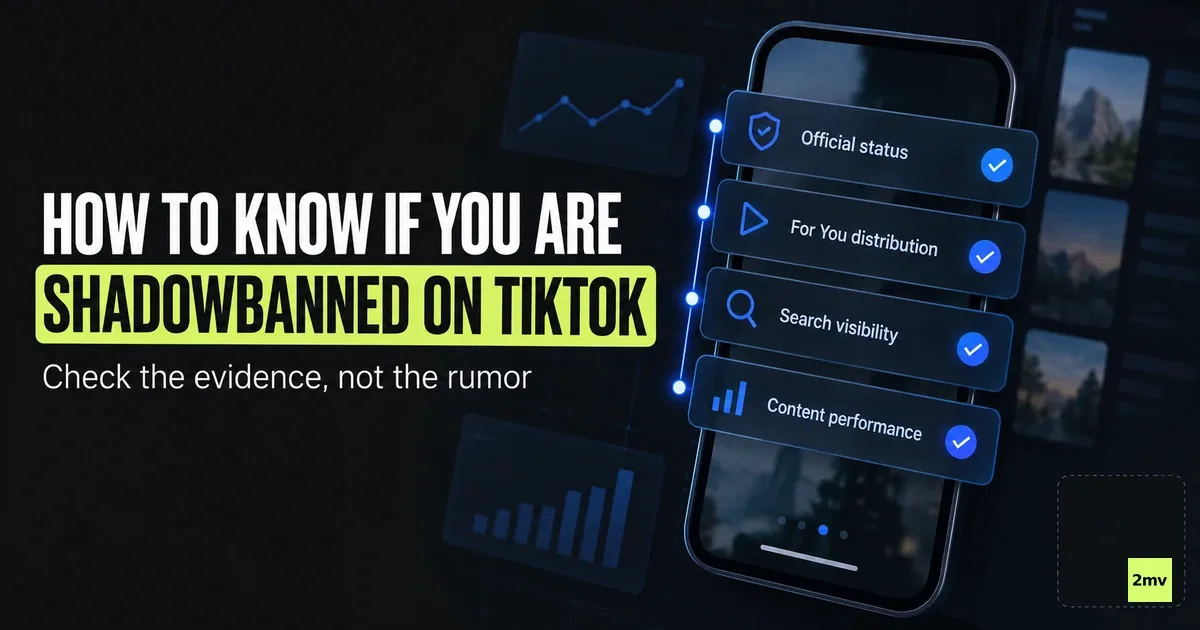
That means you can investigate a suspected shadowban, but you should not reduce the result to “views are low, therefore banned.” The best test combines official status, several recent posts, traffic sources and public discoverability.
What “shadowbanned” can mean on TikTok
Creators use one word for several different conditions:
- a post is ineligible for For You, while the rest of the account is unaffected;
- the account is ineligible for recommendation after repeatedly publishing content outside For You standards;
- content is harder to find in search;
- distribution is weak despite no restriction because viewers are not responding;
- a feature is restricted, such as posting or commenting.
TikTok’s policies support the first three as real platform states, but TikTok names them directly rather than calling them a shadowban. Its current Community Guidelines distinguish removal from For You ineligibility. TikTok separately confirms that repeatedly posting unsuitable content can make an account and its posts ineligible for For You and harder to find in search, with notification and appeal available, in Why is my account not being recommended?.
The distinction matters. A post-level decision calls for reviewing that post. An account-level notice calls for reviewing the pattern. Weak performance calls for better content evidence, not an appeal.
The evidence ladder
Not every “sign” deserves equal weight.
| Evidence | Strength | What it actually establishes |
|---|---|---|
| TikTok says the account is ineligible for recommendation | Confirmed | Account-level recommendation restriction |
| TikTok says a post is ineligible for For You | Confirmed | Restriction on that post, not automatically the whole account |
| Account Check shows a warning | Strong | A named account function or post has an issue |
| Several posts lose For You traffic at the same time | Moderate | Account-wide distribution anomaly; cause still unconfirmed |
| One exact search cannot find a post from another account | Weak | A possible search visibility issue, still confounded by indexing and personalization |
| The same previously visible exact query fails repeatedly at fixed checkpoints and from multiple observation contexts | Moderate | Persistent search visibility change; cause still unconfirmed |
| One video receives unusually low views | Weak | That video underperformed; no cause established |
| Likes or comments fall | Weak | Audience response changed; not proof of restriction |
A reliable conclusion should be based on the top of the ladder or on several independent middle-strength signals. One weak signal is not enough.
Step 1: Check TikTok Account Status
TikTok provides two routes to Account Check.
From TikTok Studio:
- Open Profile.
- Tap the Menu button.
- Select TikTok Studio.
- Under More tools, select Account check.
From the Safety Center:
- Open Profile → Menu → Settings and privacy.
- Select Support → Safety Center.
- Open Account check.
TikTok says a checkmark means no issue is shown for the listed feature or post; a warning sign indicates an issue. The current list includes login, posting, comments, profile editing and direct messages. Follow TikTok’s Account Status documentation, because menu labels can change.
Take a screenshot of any warning and record the date. “My account looked fine last week” is not enough when you later need to identify when the change began.
Step 2: Inspect recommendation eligibility on individual posts
Open the affected posts rather than treating the account as one object. Look for a notice explaining that a video is ineligible for the For You feed or has another moderation decision.
If one post is flagged and nearby posts still receive normal For You traffic, the evidence points to a post-level restriction. If multiple posts are flagged—or TikTok explicitly warns that the account is not being recommended—the scope is broader.
Read the reason before editing, deleting or appealing. TikTok’s For You rules cover content that may be allowed to remain but is unsuitable for broad recommendation, as well as integrity issues such as fake engagement and unoriginal content. An appeal should answer the reason TikTok gave, not a generic belief that the video is harmless.
Step 3: Compare For You traffic across several posts
Choose a consistent observation window, such as the first 48 hours, and compare at least several recent posts with an earlier stable batch.
Record:
- percentage or number of views from For You;
- average watch time and completion where available;
- search, profile and follower traffic;
- the post’s age when the snapshot was taken;
- whether the topic and format changed.
The important pattern is not “views are lower.” It is whether recommendation exposure disappeared across multiple posts while other variables remained reasonably stable.
If For You exposure exists but viewers leave quickly, the system did distribute the post; the audience response was weak. If For You exposure is near absent across a run of posts with no obvious content change, move to the next checks.
Step 4: Test public discoverability carefully
Search tests can identify a visibility problem, but they are easy to overstate because TikTok search is personalized and indexing can be delayed.
Use a clean comparison:
- choose a distinctive phrase from the caption or spoken topic;
- search from another account or a logged-out browser where possible;
- check the account name, exact phrase and relevant hashtag separately;
- repeat later rather than relying on one attempt;
- compare with another recent post from the same account.
Failure to appear for a broad hashtag proves almost nothing—the result set is competitive and personalized. Failure to appear for an exact, distinctive query is more meaningful, especially if older comparable posts still appear.
TikTok says posts from an account that becomes ineligible for recommendation will be harder to find in search. That makes a repeated exact-query visibility change a supporting signal for an account-level investigation, but not a universal pass/fail test or proof that a specific search ranking was manually reduced. See TikTok’s account recommendation guidance.
Step 5: Rule out ordinary distribution failure
Before calling the account restricted, test the alternatives:
- Did a viral outlier become the comparison baseline?
- Did the first seconds change?
- Did retention fall with views?
- Did the topic become narrower or less timely?
- Did the account change audience, language or publishing cadence?
- Are there enough posts to identify a pattern?
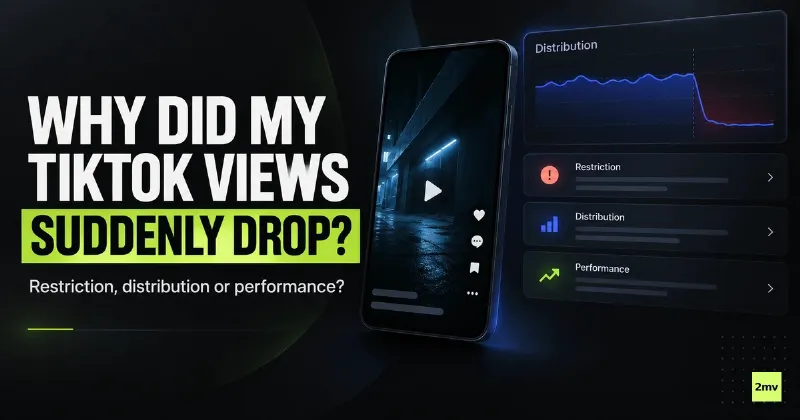
The broader diagnostic begins with a different question: what caused the decline across policy, distribution, audience and content? This article’s purpose is narrower—to judge whether restriction is a credible explanation.
Tests that do not prove a shadowban
Posting a hashtag and asking a friend to find it
Broad hashtag results are ranked, personalized and crowded. Not appearing near the top is not proof of suppression.
Comparing views with follower count
Follower count does not guarantee distribution to followers or non-followers. A large account can publish a low-performing video without being restricted.
Using a fixed view threshold
Rules such as “under 200 views means shadowbanned” ignore account size, historical range, topic demand and retention. TikTok does not publish such a threshold.
Trusting an opaque checker score
A third-party checker can analyze public statistics or guide you through a checklist. Unless it is reading an official status through an authorized interface, it cannot see a secret TikTok “shadowban flag.” Ask what signals the score uses and whether it distinguishes post-level from account-level restrictions.
Separate post-level and account-level evidence
This is the most important scope check in the investigation.
A post-level problem affects a specific video. TikTok may identify it as ineligible for For You, or the video may simply fail to expand after an initial audience test. Neighboring posts can continue to perform normally.
An account-level problem changes behavior across a run of content. TikTok may explicitly say the account is not eligible for recommendation, or several otherwise comparable posts may lose the same discovery surface at approximately the same time.
Do not promote a post-level warning into an account diagnosis. Instead, build a small scope table:
| Check | Affected post | Previous post | Next post |
|---|---|---|---|
| Eligibility notice | |||
| For You traffic | |||
| Search discoverability | |||
| Retention versus baseline |
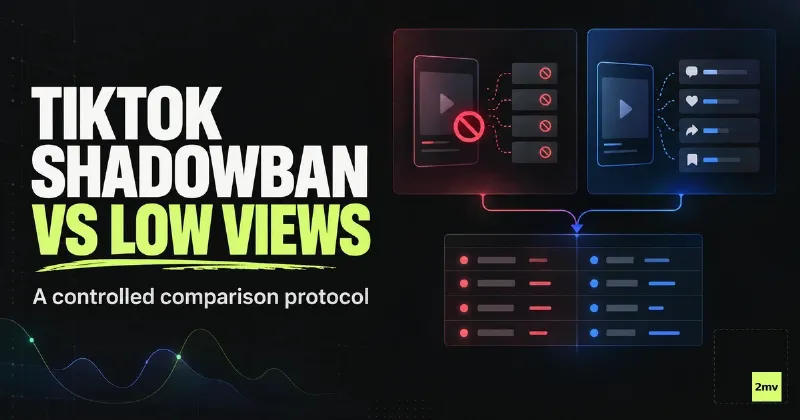
If the anomaly stays in one column, investigate the post. If it repeats across columns, an account-level investigation becomes reasonable.
Allow for timing before declaring a result
Search indexing and recommendation distribution do not have a guaranteed schedule. A visibility test performed minutes after publication is weaker than one repeated after the post has had time to appear. At the same time, waiting indefinitely turns the test into a moving target.
Use fixed checkpoints—for example, the same early and later window for every post—and record the post’s age. The exact hours matter less than consistency. A test that says “I checked sometime the next day” cannot be compared reliably with one performed immediately after posting.
Also avoid repeatedly editing captions, privacy settings or other variables during the observation window. If discoverability changes, you need to know whether TikTok changed the distribution or you changed the object being tested.
What to do when the evidence is strong
If TikTok shows a restriction:
- save the notice and stated reason;
- review the cited policy and the exact content involved;
- appeal through TikTok if the decision appears incorrect;
- stop repeating the behavior while the issue is unresolved;
- monitor whether unaffected posts retain normal discovery.
If there is no official notice but several independent signals remain abnormal, document the affected posts, dates and traffic-source changes before contacting support. Evidence is more actionable than the sentence “I think I am shadowbanned.”
Do not buy engagement, use “unban” services or create multiple accounts to evade enforcement. TikTok’s Integrity and Authenticity rules prohibit fake engagement and attempts to manipulate recommendation systems; evasive behavior can add a real policy problem to an uncertain distribution problem.
After an appeal or policy correction, verify recovery with new evidence rather than assuming the first higher-view post proves it. Look for recommendation exposure across several original posts, restoration of exact-query visibility where it was previously missing, and the absence of a continuing account notice. Recovery is a pattern too.
A defensible answer
You can say you are experiencing a confirmed TikTok recommendation restriction when TikTok identifies one. Without that notice, you can say the evidence is strong, mixed or weak based on repeated For You, search and account-level signals.
That wording may sound cautious, but it protects the decision that follows. A restriction requires policy review and perhaps an appeal. Weak content performance requires a different hook, topic or execution. Calling both a shadowban sends you toward the wrong fix.
The TikTok Shadowban Checker can turn these observations into one of four evidence states without inventing a hidden-ban percentage. Teams that need a repeatable cohort comparison can continue with the TikTok shadowban versus low views protocol.