TL;DR
- 2mv Reports is a feature inside 2mv Studio that turns viral videos into frame-by-frame breakdowns — hook, context, proof, and loop — with each beat timestamped and tied to a decision you can take to your next shoot.
- Surface metrics tell you a video performed; a report tells you why it performed, and why is the only part you can repeat.
- A report reads as a decision chain, not a summary: it earns its keep when it ends in a shot list your team can film this week.
- Reports run the same four-beat schema across TikTok, Reels, and Shorts, so the treatment transfers across platforms and niches without transferring the content.
- Reports scale where manual teardowns don't — a fixed schema, comparable output, and a library that grows with every video instead of dying in a notebook.
1. Why "Just Watch More" Doesn't Scale
Every growth team agrees, in principle, that studying winning videos is the fastest route to better short-form content. The disagreement starts at the follow-through: who watches the footage, and for how long. The honest answer for most teams is that nobody does it consistently, because doing it by hand runs into three bottlenecks that no amount of discipline fixes. Those bottlenecks are the reason a "viral video breakdown" has to exist as a feature, not just as a skill.
The first bottleneck is attention. A person can reverse-engineer a single video frame by frame, but a team cannot do that for the volume of video moving through TikTok, Reels, and Shorts in a day without abandoning every other job they have. As stated on 2mv's site, 2mv Studio monitors 12,000+ videos a day across 500+ niches — a corpus that no human analyst could ever watch, let alone break down. The scale of the content is precisely the problem that forced the breakdown itself to become automated.
The second bottleneck is consistency. Two people breaking down the same video will disagree on where the hook lands and why it works, which means the "pattern" you extract depends on who did the watching. An observation that can't be reproduced is not evidence; it is an opinion with a timestamp. Without a fixed schema, every teardown is a private interpretation, and none of them accumulate into a shared understanding.
The third bottleneck is accumulation. Even a careful manual teardown lives in a notebook or a local document, where its value dies with the person who wrote it. It is not searchable, it is not comparable, and it does not compound — so every new video starts from zero. What is missing across all three bottlenecks is the same thing: structure. When the breakdown becomes a product rather than a practice, the fields are fixed, the output is comparable, and the library grows with every video. That is the gap 2mv Reports exists to close.
2. What 2mv Reports Contains
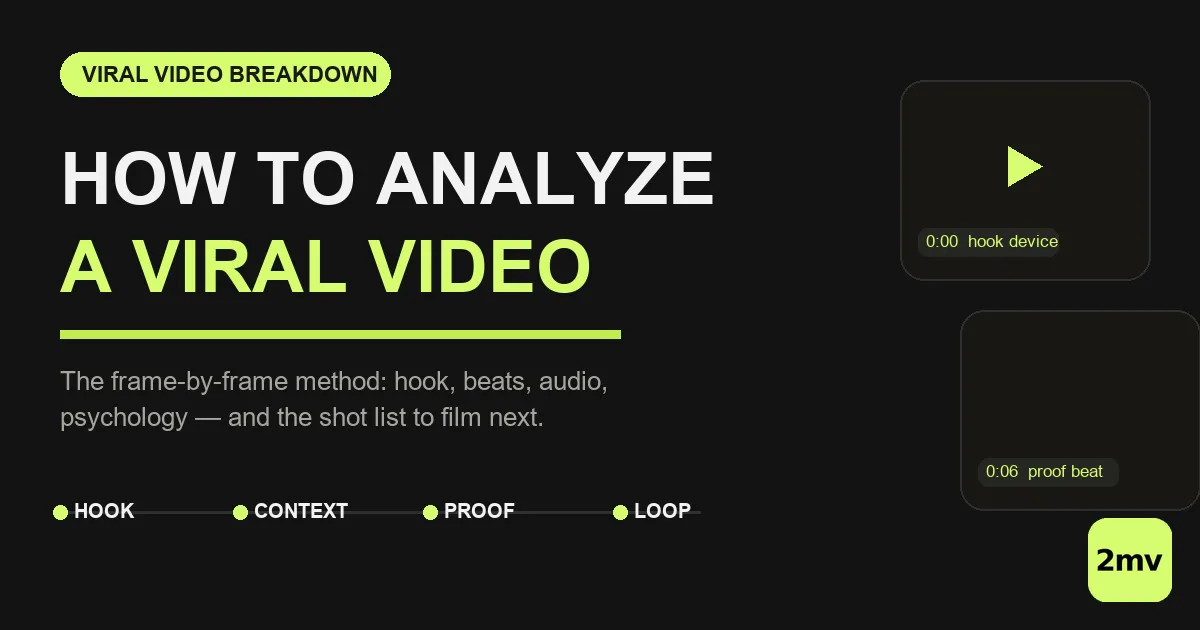
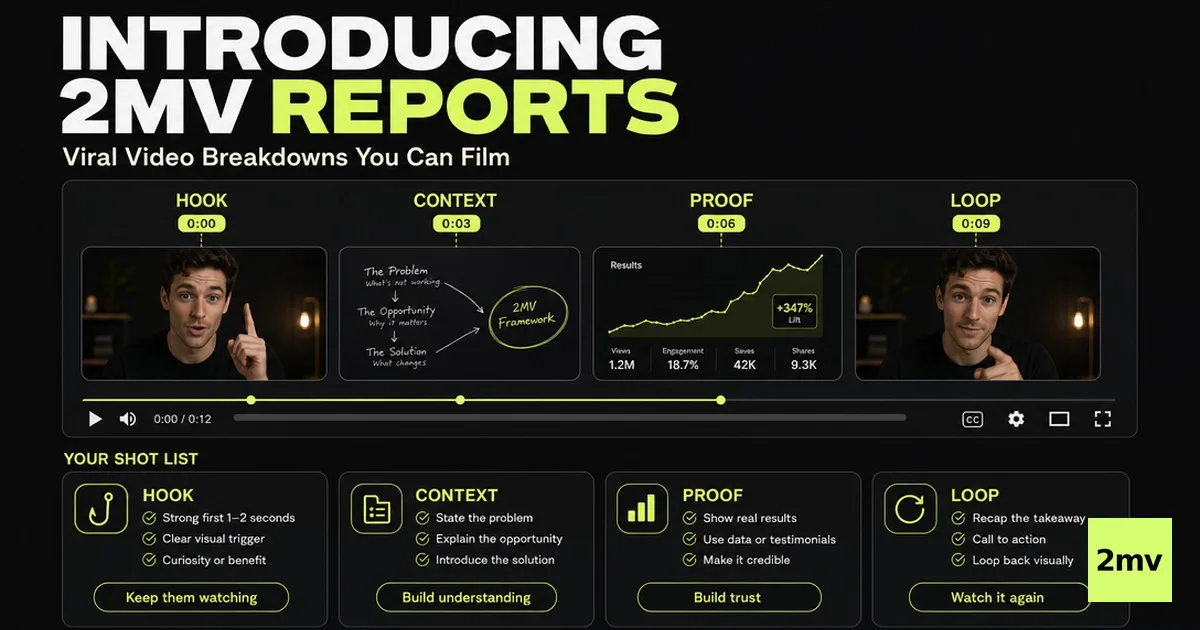
2mv Reports is the productised version of the breakdown: a frame-by-frame analysis of winning videos across TikTok, Reels, and Shorts, available on demand inside 2mv Studio. Each report takes a video that already earned millions of views and explains, second by second, why people watched and why people shared. The reports 2mv publishes as demonstrations run four beats that recur across formats — hook, context, proof, and loop — each with a timestamp and the production decision it enables:
| beat | window | what it does | the decision it enables |
|---|---|---|---|
| hook | 0:00–0:03 | stops the scroll | which pattern interrupt opens your video |
| context | 0:03–0:06 | frames the audience | who the first line signals to |
| proof | 0:06–0:09 | makes the claim visible | what evidence the claim needs |
| loop | 0:09–0:12 | closes with a repeatable prompt | what format viewers take with them |
In the worked example shown on 2mv's site, a video that pulled 1.8 million views with 82% retention breaks down cleanly along those four beats: motion-first opening, a reason to stay, a claim made visible, and a save-worthy closer. Notice what is absent from the schema — hashtags, posting time, and caption length. Those are dashboard variables that a team cannot decide during a shoot. What a report surfaces instead are structural variables: the kind of choices that actually live in the first frame, the pacing, and the payoff.
That distinction is the entire reason the report is useful. A platform dashboard tells you that a video performed and roughly who watched it; a breakdown tells you which decision earned the watch time. One is a report card, the other is an anatomy. And because the schema is fixed, the same four beats generalise across niches — the structure transfers even when the content does not, which is what lets a team reuse the treatment instead of re-inventing it for every platform.
Two design choices make the schema worth trusting rather than merely convenient. The first is that each beat carries a timestamp, which turns the report from an interpretation into a verifiable claim — you can replay the video and check whether the hook actually lands in the first three seconds. The second is that the four beats are format-agnostic: the same hook-context-proof-loop treatment applies to a talking-head explainer, a product demo, or a stitch, which is why a team can maintain one reading habit across every account it runs. A fixed schema is not a limitation on what a report can say; it is what makes the output comparable, so video thirty-one teaches your team something video five did not.
3. How a Report Becomes a Shot List
A report is finished when it produces a shot list, not when it produces a summary. Reading one properly means running the chain decode → adapt → film: you decode what the winning video did, adapt each beat to your niche and audience, and write the result as concrete filming instructions your team can execute this week.
A worked example makes this concrete. Say the report you open describes a video that opens with a motion-first hook — the creator gestures at an object while a text overlay asks a question, all within the first two seconds. Your adapted version does the same structural job without copying the content: your product enters the frame in motion, a question sits on screen, and the first line names the audience. The proof beat in the winning video shows a before-and-after; yours shows a real metric from your own customers. The loop beat ends on a reusable prompt; yours ends with a format your niche saves and reposts. The output of the session is five to eight lines of filming instructions, not a paragraph of praise.
The reading discipline matters as much as the schema. For the hook, ask what interrupted the scroll and whether an information gap opened in the first three seconds; if the video reaches ten seconds without closing it, the hook was performing on momentum, not structure. For the context beat, check whether a new viewer knows within a second and a half that this is for them. For the proof, ask whether the claim is made visible rather than asserted. For the loop, look at the final seconds and name the format a viewer could carry away. Every answer maps to a choice you will make on your own shoot — which is the test that separates a report you act on from a report you admire.
Three misreadings are common enough to name. The first is treating the report as a summary — reading it once, agreeing that the video was well made, and closing the tab without writing a single instruction. The second is skipping the adapt step and filming a near-copy, which is exactly how a breakdown turns into a platform-policy problem rather than a growth asset. The third is reading only the hook and ignoring the loop, which misses the half of the video that earned the shares. All three fail the same test: they stop before the shot list exists. If the session ends without five to eight lines of filming instructions, the report has not been used — it has been read.
4. Where Reports Fit in 2mv Studio
Reports are one view in a larger workflow, and their value grows when they are used as part of it. The Lab runs five views on top of the same monitored corpus: Market Signals surfaces what is rising before it peaks, Target Tracking follows accounts and competitors, Reports decode individual winners, Content Patterns cluster those breakdowns into repeatable structures, and Viral Playbook turns the result into an executable content plan. A single report is a data point; the clustering and the playbook are what turn data points into a growth curve. That is the same five-engine loop we describe in our article on what 2mv is, where the breakdown is the decode stage.
For teams, the practical difference shows up in the deliverable. A report ships as an exportable insights document inside the Lab, and the Pro plan adds team collaboration on reports, as stated on 2mv's site. That is what turns a personal observation into a shared asset: the same schema, the same format, comparable across videos, searchable across the library, and exportable to whoever owns the shoot. A growth team of two can now hold a research depth that previously lived inside a six-figure retainer.
The research workflow is where the time saving shows up. In customer testimonials on 2mv's site, a growth lead describes cutting video research from a full day to about twenty minutes, and a creator describes planning a video off a single report that passed eight million views in a week. Treat those as marketing claims rather than independent verification — but they describe the same structural shift the feature is built for: the work moves from watching to deciding. 2mv Studio is the home for that workflow, and if the answer is a partner rather than an in-house system, our guide to the best social media marketing agencies sorts the operating partners from the vendors.
A practical rhythm makes that workflow concrete. On Monday, the team scans Market Signals and picks the three winners in the niche worth breaking down. On Tuesday, they read the three reports and extract the beats that repeat — the pattern that survives across different videos is the one worth betting on. On Wednesday, they write the adapted shot list for the week. On Friday, they film. The reports do not sit at the start of that loop as inspiration; they sit in the middle as the decision input, and the playbook view turns the accumulated breakdowns into the strategy the next Monday starts from. Teams that run the loop weekly find that the pattern library becomes the asset they keep when any individual post underperforms.
5. What Reports Don't Do
Three things keep a breakdown practice honest, and they double as the feature's honest boundaries. The first is sample size. A single report proves that one hook worked for one audience at one moment — it does not prove the hook is a repeatable pattern for you. The discipline is to look across ten to twenty winners in your niche and count how often a structure repeats before treating it as a pattern. A library of reports showing the same opening beat is worth more than twenty different videos analyzed once.
The practical version of that discipline is a simple counting exercise. Keep a shared table with one row per video: the hook type, the proof format, and the loop format. After ten rows, sort by hook type and count. If the same opening beat shows up in six of ten winners, that is a candidate pattern worth testing on your own next video — not because one report proved it, but because the repetition across a sample did. The same exercise applies to the proof and loop columns, and it is the difference between copying a single video and building a library of structures you can rotate through.
The second is platform rules. A report names the structure, not the licence. Copying another creator's music, script, or caption text still violates platform terms and creator rights, even when the breakdown makes the structure easy to see. Translate the structure, not the content.
The third boundary is the difference between a pattern and a promise. A report tells you what has been observed to work; it does not guarantee that the same structure works for you, this week, in your niche. Any system reduces luck — none removes it. If a tool promises guaranteed views, that is a marketing claim about the future, not evidence from the past. Reports are an input to better decisions, and they stay that way.
Conclusion
The gap between a viral video and your next video is usually not talent — it is structure. A team that can name the hook, the proof, and the loop of a winning video can point at what it is trying to replicate, which is the first requirement for improving it. 2mv Reports makes that first requirement reachable: the breakdown that used to be a personal skill, done by hand and lost in a notebook, becomes a fixed-schema feature that scales, accumulates, and exports.
Start with a single report. Open 2mv Studio, pick a niche, and read one breakdown end to end — not to admire it, but to write down what you would change in your own first three seconds. If that exercise produces a shot list you can film this week, the report has done its job, and the rest is cadence.
FAQ
What is a 2mv Reports breakdown?
A 2mv Reports breakdown is a frame-by-frame explanation of why a viral video earned its views — the hook, structure, script, and triggers that produced the outcome — delivered as a timestamped report with a production decision attached to each beat. It runs inside 2mv Studio and covers TikTok, Reels, and Shorts.
What's inside a breakdown report?
Each report decodes a winning video into four beats: hook (0:00–0:03, what stops the scroll), context (0:03–0:06, who the opening signals to), proof (0:06–0:09, how the claim is made visible), and loop (0:09–0:12, the format viewers carry away). It deliberately excludes dashboard variables like hashtags and posting times.
How is a report different from standard platform analytics?
Standard analytics report what happened — views, watch time, audience demographics. A report reports why it happened, down to the decisions inside the video. One is a report card; the other is an anatomy.
How do I turn a report into a video?
Run the chain decode → adapt → film. Decode what the winning video did, adapt each beat to your niche without copying the content, and write the result as concrete filming instructions — five to eight lines your team can execute this week.
Does a report guarantee my next video goes viral?
No — treat any tool that promises guaranteed views with suspicion. A report raises the quality of your starting information; the outcome still depends on execution, audience, and timing. Reports describe what has been observed to work, not what will work for you this week.
Which plan includes Reports?
Reports are part of 2mv Studio. The Studio page currently lists Kick-Off at $139/month, Pro at $399/month, Scale at $999/month, and custom Enterprise pricing. Check the current Studio page before making a purchasing decision because plan details can change.