TL;DR
- No platform publishes a view count that makes a video viral, because none of them uses one. The honest math is relative: a video goes viral when the recommendation system carries it far beyond its own account's baseline — often many times the account's median — which is why 100,000 views can be a breakout for one account and background noise for another.
- Search results disagree wildly (10,000? 100,000? 1 million?) because each source is quoting a different account size, platform, and year while calling all of it "viral."
- TikTok, Instagram Reels, and YouTube Shorts all distribute through recommendation systems, not follower feeds, and each discloses different signals: interactions on TikTok, watch time and sends per reach on Reels, "viewed vs. swiped away" on Shorts.
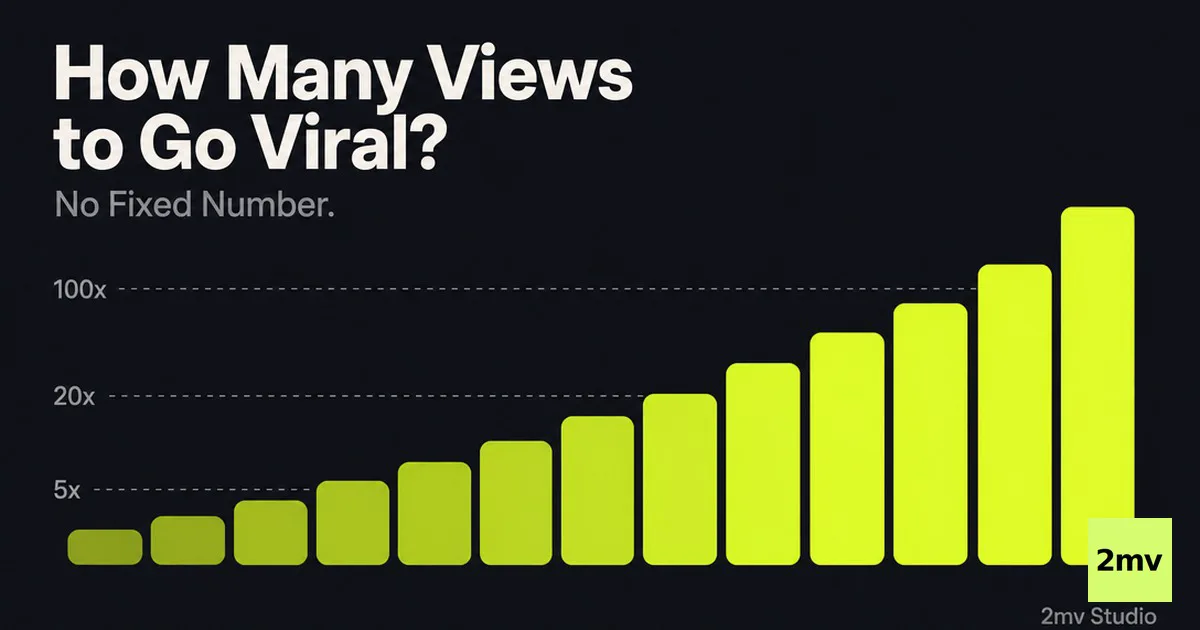
- A practical replacement for the threshold question: grade your videos as multiples of your own median — roughly 5x is a solid hit, 20x is a breakout, 100x is a culture-level outlier. It is an analysis lens, not a platform standard.
- Going viral rarely pays directly: TikTok's Creator Rewards are commonly reported at well under $1,000 per million qualified views, while brand deals — the real money — scale with the audience a viral moment leaves behind.
1. Why No Two Sources Agree on a Number
Ask how many views a video needs to go viral and the search results will hand you a different figure from every tab: some say 10,000, most call 100,000 "semi-viral," a million views within a day or two is the folk consensus, and a few demand three to five million before the word applies. All of those numbers get stated with confidence, and all of them contradict each other. The disagreement is not sloppiness on the part of the people answering — it is the visible symptom of measuring a relative event on an absolute scale.
The core problem is that a fixed view count answers a question the platforms never ask. Recommendation-driven feeds do not sort videos against a global leaderboard; they sort them against other candidates competing for the same viewer's next thirty seconds. A video's performance is therefore judged against its own starting conditions: the account it came from, the niche it sits in, the size of the audience pool it was first tested on. One hundred thousand views on an account whose median is 3,000 represents a fundamentally different event than one hundred thousand views on an account whose median is 900,000 — the first is the system escalating a winner, the second is the system doing its normal job.
So what does it actually mean to have a video go viral? The definition that survives contact with the data is about distribution outrunning the account's own gravity: the recommendation system kept finding new audience pools for the video after the account's existing reach was exhausted. Once you define the event that way, the search results stop contradicting each other — each quoted number is just the absolute footprint of an over-performance event on an account of a particular size. The number was never the mechanism. That is the honest math, and the rest of this article walks through what the platforms actually disclose, a usable framework built on it, and what the event is worth once it happens.
2. How Many Views to Go Viral? What the Platforms Actually Say
The direct answer: none of the major short-form platforms publishes a view threshold for virality, because none of them distributes that way. There is no form to fill out at a million views and no switch that flips at 100,000. The platforms disclose how videos get distributed, and the disclosures all describe multiplication processes rather than gates.
TikTok's newsroom explains that the For You feed is built from recommendation factors — the interactions users give (likes, shares, comments, and how much of a video they watch), video information such as captions, sounds, and hashtags, and device or account settings like language and location (How TikTok recommends videos #ForYou). Notably absent from that list is the creator's follower count, which is why an account with two hundred followers can reach more people in a weekend than one with two hundred thousand. Distribution works in tested batches: a video is shown to an initial pool of viewers, the signals it earns there decide whether the system shows it to a larger pool, and the process repeats. Views therefore arrive in steps, each step earned by the last.
This is why any single number misleads. The system never checks how many views a video has accumulated; it keeps asking whether the video over-performed the audience it was just tested on. "Going viral" is the name we give to the steps compounding — the system repeatedly deciding that a video beats its previous pool. A threshold, by contrast, implies the count itself matters — that at some number, something switches on. Nothing switches on. The video simply keeps winning its next audition, or it stops, and the audience size at which it stops depends entirely on where it started.
3. TikTok, Instagram Reels, and YouTube Shorts: Three Spread Mechanics
All three major short-form platforms distribute through recommendation rather than follower graphs, but they disclose different signals, and those differences change what "over-performing" looks like on each one. Treating the three platforms as interchangeable is a common and expensive mistake, because a video's baseline, its ceiling, and even the meaning of its view count differ by platform.
On TikTok, the mechanism is the batch-tested escalation described above, with completion and rewatch behavior carrying the most weight among interaction signals in practice. A video that gets finished and rewatched keeps advancing to new pools; a video that earns fast taps-away stalls early. The view total is the output of that process, which is why TikTok folklore talks about "the first hour" — it is really talking about the first audition pools.
On Instagram, Reels distribution leans heavily on non-follower reach, and head of Instagram Adam Mosseri has repeatedly named three signals as mattering most for Reels: watch time, likes per reach, and sends per reach — how often viewers share the Reel into a direct message relative to how many saw it. Sends per reach carries particular weight for reaching non-followers, which effectively makes private sharing the platform's distribution currency. Instagram also introduced Trial Reels in December 2024, a feature that shows a new Reel to non-followers first, institutionalizing the "audition before your audience sees it" model.
On YouTube, Shorts live inside a recommendation shelf, and the view count itself changed meaning on March 31, 2025, when YouTube began counting a view every time a Short starts playing or replays, with no minimum watch time. To keep the inflated headline number honest, YouTube separately surfaces "engaged views" and a "viewed vs. swiped away" indicator, and its own guidance tells creators to watch the swipe-away ratio rather than the raw total. A million Shorts views, in other words, measures reach; the engaged views figure measures pull.
The practical consequence of three different mechanics is that baselines do not transfer. The same account posting the same video on all three platforms will produce three different medians and three different ceilings, and none of the numbers are comparable. Teams that benchmark one platform's numbers against another's end up either falsely encouraged or falsely discouraged. The unit of measurement that survives cross-platform work is the multiple — how far a video beat its own account's median, on that platform, in that niche.
4. A Baseline Framework: 5x, 20x, 100x
If virality is relative, the useful unit is a multiple of your own median, not a raw count. To make that usable in practice, here is the working framework we apply when sorting a channel's uploads into performance tiers — it is an analysis lens for comparing videos within one account's history, not a platform standard, and different teams will draw the boundaries in slightly different places:
- 5x baseline — a solid hit. The system tested the video, the signals were clearly positive, and it reached several times the account's normal pool. Worth studying, but common enough that it usually reflects the account's existing formula working.
- 20x baseline — a breakout. This is the tier that industry roundups typically have in mind when they say "viral": the video escaped the account's normal ceiling by an order of magnitude and reached audiences with no prior relationship to the creator.
- 100x baseline — a culture-level outlier. The video left the niche entirely and became ambient. These are the videos that get write-ups in press coverage and imitations within the week.
A worked example shows why the framework dissolves the search-result disagreement. Take an account whose median video earns 4,000 views: its 5x tier starts around 20,000 views, its 20x breakout line sits near 80,000 — right where the "semi-viral at 100K" folklore begins — and a 100x outlier lands near 400,000. Now run the same multiples on an account with a median of 500,000: the identical 20x breakout line moves to 10 million views, a number the first account will never see in its lifetime. Both accounts experienced the same event — the system escalating a winner twenty-fold — but the absolute footprints differ by a factor of 125, which is precisely the spread of answers on the first page of search results.
Two cautions keep the framework honest. First, use the median of recent uploads, not the mean, because a single old viral video inflates the mean and quietly lowers every future video's apparent over-performance. Second, resist grading other people's videos against your account's baseline — the multiple only means something within one account's own history, since audience pools, follower graphs, and niche competition differ. When you grade a competitor's breakout, you are estimating their baseline first, which is exactly the step most surface-level comparisons skip. That estimation-and-decoding work — turning an outlier into instructions — is its own discipline, covered step by step in our guide to analyzing a viral video.
5. What a Viral Video Actually Pays
The money question behind the threshold question usually sounds like this: if I hit the number, do I get paid? The honest answer is that views convert to money through two separate channels — platform rewards and brand deals — and neither begins automatically, while the platform channel pays far less than the folklore suggests.
TikTok's Creator Rewards Program is the main direct-payout channel, and its published eligibility bar already filters most accounts: at least 10,000 followers, at least 100,000 valid views in the last 30 days, age 18 or over, a personal account in an eligible region, and — the detail that surprises people most — only videos longer than one minute earn rewards (TikTok Creator Academy). TikTok does not publish a fixed rate, saying earnings depend on factors like qualified views, watch time, and audience region; creator-economy trackers commonly report the realized rate at roughly $0.40 to $1.00 per 1,000 qualified views as of September 2026. Run that arithmetic and a one-million-view video earns in the neighborhood of $400 to $1,000 from the platform itself — life-changing attention, grocery-money revenue.
The second channel is where the economics actually live. Brand and sponsorship deals price off audience and engagement rather than off any single video, which means a viral moment's real payout is its effect on the rate card. Influencer Marketing Hub's TikTok earnings calculator and rate benchmarks put micro-influencers (roughly 10,000 to 100,000 followers) at around $100 to $125 per sponsored post, its worked example for an account near half a million followers at roughly $844 to $1,266 per post, and its example for an account near 19 million followers at roughly $29,000 to $45,000 per post (Influencer Marketing Hub). Against those figures, a breakout that converts into a few thousand engaged followers usually out-earns its own platform payout by an order of magnitude — which is why the people who benefit most from virality are rarely paid for the video, and almost always paid for the audience the video built.
That distinction carries a caution: a single spike is an event, not an income. Sponsorship rates follow sustained attention, qualified-view rewards require the eligibility bar to hold across every upload, and neither channel pays at all for a video that spikes and leaves no one behind. The creators and brands who treat virality as revenue treat the over-performing video as a door — what matters is whether anyone walks through it and stays.
6. Trade the Threshold for a Baseline
Every number quoted in the first section of this article came from someone else's account, someone else's niche, someone else's year. The practical upgrade is to stop asking "how many views is viral?" and start asking "how far above my own baseline did this video go, and what in it caused that?" The first question produces anxiety and folklore; the second produces a research loop you can actually run.
Baseline thinking is a small system, and it starts with data you already own. Establish your median across recent uploads, grade every new video as a multiple of it, and archive anything that clears your breakout line. Platform-native analytics — TikTok Studio, Instagram Insights, YouTube Studio — give you all of this for free, and for a single account getting started they are genuinely the right tools. The work gets heavier when the question expands from "how did my video do?" to "what is over-performing across my niche right now?", because that requires other accounts' baselines, not just your own, and no native dashboard exposes them. It is the same shift from watching numbers to decoding winners that our overview of how 2mv approaches viral research describes — 2mv is an agentic growth agency and the team behind 2mv Studio, built around the premise that over-performance is a researchable pattern rather than luck.
That is also where the baseline lens turns into tooling. Sorting candidate videos by how far they beat their own account's median — rather than by raw view counts, which only ever surface the biggest accounts — is exactly the over-performance ranking built into Viral Video Finder, and it exists because absolute counts answer the wrong question for everyone except the largest creators. Whatever tooling you choose, the loop is the same: find the outliers, grade them as multiples, decode why they escaped, and feed what you learn back into the next batch. The threshold mindset asks the internet for a number. The baseline mindset builds one.
7. Conclusion
There is no view count at which a video officially becomes viral, and the sooner a content operation stops looking for one, the faster it starts measuring what matters. The platforms distribute through relative over-performance; the money follows the audience a breakout leaves behind; and every quoted threshold on the internet is just one account's absolute footprint of an event that only makes sense as a multiple. Grade your uploads against your own median, treat every 20x video as research material rather than a lottery ticket, and let the loop — measure, decode, adapt, repeat — do the compounding. When you want that over-performance ranking running across your niche instead of just your own channel, Viral Video Finder sorts exactly that way, and no tool will ever promise you the number itself — because the honest math says the number was never the point.
FAQ
Is 100k views viral on TikTok?
It depends entirely on the account that earned it. For an account whose videos typically get 2,000–5,000 views, 100,000 views is a genuine breakout of roughly 20x or more — most people would call that viral. For an account that routinely clears 500,000 views, the same number is an underperformer. Judge the multiple, not the raw count.
Do you get paid if a video goes viral?
Not automatically, and usually not much from the platform. Direct payouts require enrollment in a program like TikTok's Creator Rewards, which has eligibility requirements (follower minimum, 30-day view minimum, videos over one minute). A viral video outside those programs earns nothing by itself; the money typically arrives later through sponsorships and the audience the video built.
How much does a viral video make?
From platform rewards, commonly reported at roughly $0.40–$1.00 per 1,000 qualified views on TikTok — so a 1-million-view video might earn $400–$1,000, and only if it qualifies. From brand deals, the same breakout can be worth far more if it lifts the creator's rate card: industry benchmarks put sponsored-post prices from the low hundreds for micro-influencers into five figures for accounts near 19 million followers.
Can a video go viral days after posting?
Yes, and it is more common than people assume. Recommendation systems re-test older videos when a new audience pool responds well, so a video can sit near its account's median for a week and then escalate suddenly — creators call it delayed virality or "the algorithm found it late." This is another reason to date-stamp your numbers when researching: a video's total is a moving target.
How many videos does it take to go viral?
There is no fixed count, and anyone quoting one is describing their own sample. What the baseline framework makes visible is that breakout frequency is a distribution property: channels that post consistently within a decoded pattern tend to produce 5x hits regularly and 20x breakouts occasionally, while accounts that change style every video reset their own pattern to zero. Volume without consistency produces noise; consistency is what gives outliers a chance to compound.
Do you need a minimum follower count to go viral?
For distribution itself, no — TikTok states its recommendations weigh interactions and video information rather than follower count, and every platform has small accounts with enormous videos. Follower minimums appear only in monetization programs, such as the 10,000-follower bar for TikTok's Creator Rewards. An account can go viral with 50 followers; it just cannot always invoice for it.