TL;DR
- To analyze a viral video is to reconstruct, beat by beat and frame by frame, the decisions inside the video that earned the attention — then convert those decisions into a shot list for your own next video. Watching explains nothing; a breakdown names the hook device, the pacing, the payoff, and the reason viewers shared it.
- The work has five passes: confirm the video is a real outlier, deconstruct the first two seconds, map the structure without sound, layer audio and psychology back in, and write the shot list.
- The single most common failure is stopping at admiration — agreeing the video is well made without writing a single production instruction.
- A useful breakdown ends in five to eight lines you could hand to whoever holds the camera this week. If it does not, it is a review, not an analysis.
- Manual breakdowns cost roughly half an hour per video; an automated AI video analyzer compresses the same passes into minutes when you need to run them across a whole niche.
1. Watching Is Not Analyzing
Every growth team agrees in principle that studying winning videos is the fastest way to make better ones. The disagreement starts at the follow-through, because almost nobody defines what "studying" means. Most teams rewatch a viral clip, nod at the timing, maybe screenshot a clever caption, and move on with a vague intention to "do more like that." That loop produces feelings, not instructions — and feelings cannot be handed to a creator, compared across videos, or improved next week. The gap between watching and analyzing is the gap between consuming content and engineering it.
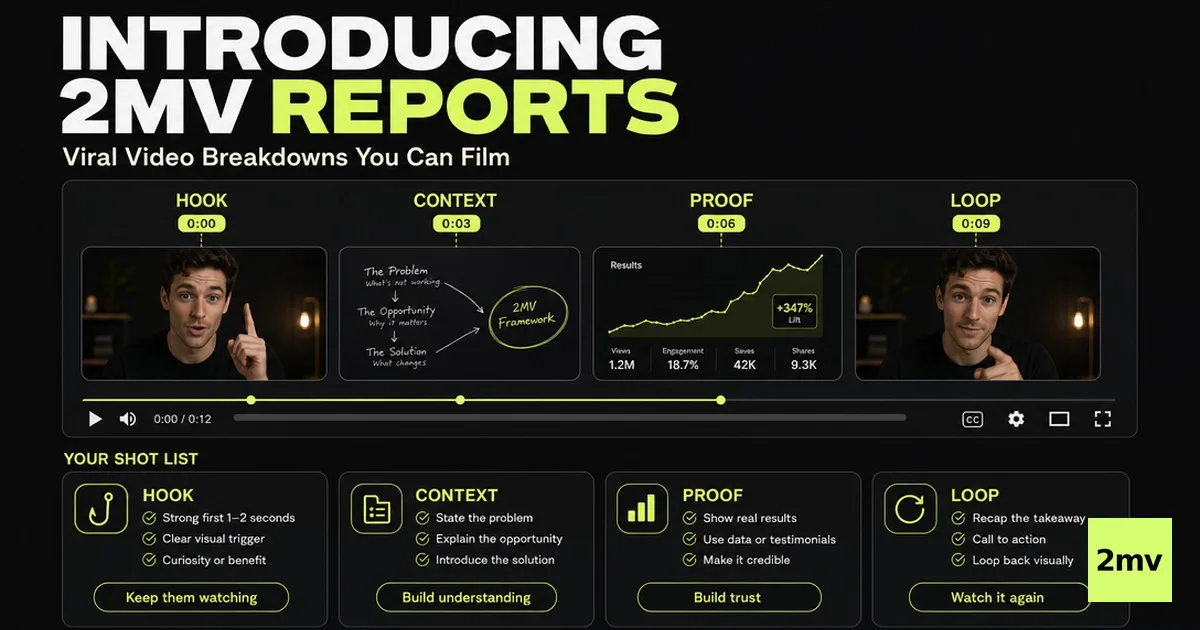
The distinction matters because short-form performance is decided by decisions, not by vibes. A video earns millions of views because someone chose a specific hook device in the first two seconds, chose a cut rhythm that held attention past the drop-off point, chose an audio track that carried the middle, and chose a closer that made sharing feel natural. None of those choices are visible at normal playback speed, and none of them survive a casual rewatch. As we covered in our introduction to 2mv Reports, surface metrics tell you that a video performed; only the breakdown tells you why it performed — and the why is the only part you can repeat.
This article gives you the working method: five passes through a single viral video, in order, each with a concrete output. Run it manually and a full breakdown takes about half an hour. The passes are the same ones automation runs at scale — the manual version simply teaches you what to demand from the results.
2. What Analyzing a Viral Video Actually Means
A viral video analysis has two layers, and confusing them wastes most people's effort. The first layer is the baseline: establishing that the video genuinely over-performed, rather than riding a trend, an account's existing audience, or a paid boost. The second layer is the craft: the internal decisions — hook, structure, pacing, visuals, audio, psychology — that converted attention into shares. Analytics tools own the first layer almost exclusively; the second layer is where breakdowns live, and it is the layer that transfers to your next shoot.
The order is not optional. Craft analysis applied to a video that only performed because of its account's audience produces confident nonsense — you will faithfully decompose decisions that did not cause the outcome. This is why the method below starts with a baseline check before it lets you anywhere near the frames. It is also why the deliverable of a real analysis is production guidance rather than praise: the output should name what you would do differently in your own first two seconds, not rate the video on a five-star scale. The weight professional strategists put on this layer is easy to underestimate — YouTube strategist Paddy Galloway advises spending roughly thirty percent of total effort on ideation and packaging, because that is where the difference between a decent video and a breakout one is decided, a discipline he has applied across channels he has grown to tens of millions of subscribers (Colin and Samir interview).
One more boundary keeps the method honest. Analyzing why a video worked is a different job from finding which videos to analyze in the first place — that discovery discipline (audience problems, early signals, outlier hunting) deserves its own workflow, and we treat it separately in our guide to finding viral content ideas. This article assumes you already have a winning video in front of you. The job now is to take it apart.
3. Step 1 — Confirm It Is Actually an Outlier
Before touching the frames, establish the baseline with one question: did this video dramatically outperform the account's own median, or did it merely perform normally for a large account? A million views means something different on a channel whose average is fifty thousand than on one whose average is nine hundred thousand. Open the creator's profile, eyeball their last twenty or thirty uploads, and place the video on that distribution. Only clear outliers — the two or three videos that dwarf everything else the account published — are worth a frame-by-frame session, because those are the videos where the craft, not the audience, did the work.
Second, weight the engagement mix toward shares and saves rather than likes. Likes are the cheapest signal a viewer can give; shares and saves mean the video moved someone to spend social capital or plan a return visit, which is the behavior that actually spreads a video. A breakdown candidate with an ordinary like count but an unusual share-to-view ratio is a better research subject than a like-magnet with no shares, because shares are the outcome you want your own videos to reproduce.
Finally, timestamp the snapshot. View counts keep climbing after you analyze a video, so record the date and the number when you start. This one habit is what makes breakdowns comparable across weeks — a notebook full of undated numbers is not a pattern library, it is trivia. Teams that skip this step end up unable to say whether the pattern they spotted in March was still working in September. If scanning profiles by hand sounds heavy, dedicated outlier tools do exactly this screening step — 1of10, for example, built its whole product on surfacing videos that dramatically over-perform their channel's baseline, and it is a reasonable way to feed candidates into the craft analysis below.
4. Step 2 — Deconstruct the First Two Seconds
The hook is where most breakdowns should spend a third of their total time, because short-form platforms make most of their retention decision before the average viewer has finished reading a caption. Replay the first two seconds frame by frame — most players allow arrow-key stepping, and phone apps like TikTok let you scrub precisely. You are looking for the hook device: the specific mechanism that interrupted a scroll. Common devices include motion in the first frame (an object entering, a hand already mid-gesture), a text overlay that opens an information gap, a familiar object used in an unfamiliar context, and a spoken first line that names the audience outright.
Name the device in one sentence, because naming is what makes hooks reusable. "Good hook" is an opinion; "motion-first hook: product enters frame before the creator speaks, with a question overlaid by frame twelve" is a device you can schedule a shoot around. While you are in the first two seconds, note the framing and composition too — how much of the frame the subject occupies, whether text sits in the safe zone, and what the very first visual promise is. A surprising number of viral videos commit to their visual promise within the first fifteen frames.
Here is the discipline that separates analysis from appreciation: after naming the device, write the adaptation question. If the hook was a before-and-after reveal in the first second, your question becomes "what is the before-and-after in our product?" If it was a bold claim on screen by frame ten, the question is "which of our numbers survives being read in half a second?" Every hook observation should end in an interrogative aimed at your own content — that is what turns somebody else's winner into your planning material.
5. Step 3 — Map the Structure Without Sound
Now watch the middle of the video, muted, and map its structure as a beat sequence. Muting is the trick: it forces you to see the visual rhythm instead of drifting along with the narration. Sketch the video as beats — a beat being a change in what the viewer is looking at or processing. Note where each beat starts, how long it runs, and what changed: a new scene, a new prop, a caption swap, a zoom, a hard cut. Most short-form winners re-trigger attention every one to three seconds with some kind of visual change, and the mute pass is how you see that skeleton directly.
While mapping, pay attention to three structural variables. First, cut rhythm: how many visual changes per second, and does the pace accelerate at any point? Second, information order: does the video show the outcome first and explain after, or build toward a payoff? Third, the loop: whether the ending connects back to the opening so a rewatch feels seamless — looping closers quietly double a video's effective watch time. Write the beat map as a simple numbered list with timestamps; six to twelve beats is typical for a sixty-second video.
The beat map is also where you spot what the video refused to do. Many winners hold a single static shot for an unexpectedly long beat, betting that a strong spoken claim beats visual churn. Others never show the creator's face at all. These negative decisions are as transferable as the positive ones, because they tell you which rules your niche actually enforces — and which ones exist only in advice threads.
6. Step 4 — Layer Audio and Psychology Back In
With the visual skeleton mapped, replay with sound and mark what the audio is doing to retention. Is the track doing the pacing (cuts landing on the beat), or is a voiceover doing it (cuts landing on sentence boundaries)? Note where sound design — a whoosh, a silence, a sudden stop — marks a beat transition, and whether the music's energy curve rises with the video's tension or deliberately contrasts with it. Audio is the layer viewers cannot articulate, which is exactly why it survives copying attempts: competitors see the visuals and miss the mix.
Then replay once more for psychology, naming the mechanism each beat pulls. Short-form videos run on a small set of levers: curiosity gaps that open in the hook and close late, status signals that let viewers feel like insiders, relief after tension, and proof that makes a claim visible instead of asserted. At each beat, write which lever is active. A video that seems "just fun" usually turns out to be running two or three levers in sequence, and the sequence — not the fun — is what you can rebuild.
The comment section is your evidence check for this pass. Creators and viewers will literally narrate the lever that got them: "the way he said wait for it," "I came for the recipe and stayed for the story." Treat comments as a free audience panel that confirms or contradicts your beat-by-beat reading. Where the comments praise something your map marked as incidental, your analysis has a gap — go back and find what you missed.
7. Step 5 — Write the Shot List
A breakdown is finished when it produces a shot list, not when it produces a summary. The conversion chain is decode, adapt, film: decode what the winning video did (passes one through four), adapt each device to your niche and product without copying its content, and write the result as five to eight concrete lines. "Hook: our product enters frame mid-motion, text overlay asks the question customers actually type." "Beat two: before-state on screen for one second — resist explaining." Each line names a decision someone will make on the shoot, which is what makes it executable.
Adaptation is where judgment lives, and where the legal line sits too. You are translating structure, not transcribing content: the hook device, the beat rhythm, the lever sequence — not the script, the music, or the specific footage, all of which belong to their creators. Translate the mechanism and the platform's terms stay on your side of the line; copy the expression and no amount of analysis protects you. A practical test: if your adapted line could be mistaken for the original video's, adapt again.
Keep the shot list with the timestamped snapshot from step one, in one shared place. Five analyzed videos with shot lists and dates is a pattern library. Twenty is a strategy. The library is the asset — individual videos decay, but a table of devices that kept working across months in your niche is the closest thing organic growth has to inventory.
8. Where Tools Earn Their Keep
Honest costing: done manually, the five passes take twenty to forty-five minutes per video, and the quality of pass two and three improves noticeably with a scrubbing player and a second monitor. For a weekly cadence on a single niche, that investment is worth making by hand at least a few times, because manual breakdowns teach you what a good result looks like. You learn to distrust summaries and to demand named devices, timestamped beats, and adaptation questions.
The economics change when the question becomes "what is working across my whole niche this week?" Nobody can run five passes on two hundred videos by hand, and sampling badly is worse than not sampling — a niche-level pattern needs the whole corpus, not your ten favorites. This is the gap an automated analyzer fills: an AI video analyzer runs the same passes — hook device, beat map, audio retention, psychology, audience — on any link you paste, in minutes, with the output formatted as decisions rather than scores. Manual analysis is how you learn the craft; automated analysis is how you apply it at the speed a niche moves.
The two modes are complements, not rivals, and the dividing line is volume. Break down the two or three videos that matter most to your strategy by hand, deep enough to argue with the result. Let a tool sweep the long tail so the outliers find you. Whichever mix you choose, hold both to the same finish line: no session ends without a shot list.
Conclusion
Do not confuse a single breakdown with a pattern. One analyzed video tells you what worked once for someone else; a repeated device, counted across ten or twenty outliers in your niche, is the beginning of a strategy you can actually schedule against. The method in this article is deliberately repeatable — baseline, hook, structure, audio and psychology, shot list — because repeatability, not brilliance, is what compounds. If your notebook contains admiration but no shot lists, you have been watching, not analyzing; the fix takes one session. Run the five passes on the last video that made you jealous, write the eight lines, and let the loop — the same loop that powers 2mv Studio at scale — do the rest.
FAQ
How many views count as a viral video?
There is no absolute number — virality is relative to the account's own median. A video with 100,000 views on a channel that averages 5,000 is a better analysis subject than one with 2 million views on a channel that averages 1.5 million, because the over-performance is what proves the craft did the work. The full math — platform thresholds, payout ranges, and why quoted numbers conflict — is in how many views it takes to go viral.
Can ChatGPT or another chatbot analyze a viral video?
Only partially. General-purpose chatbots can describe what happens in a video, but they are not built for short-form performance analysis — the frame-level questions of hook devices, beat timing, and retention pacing. Dedicated analysis treats the video as a set of production decisions; a chatbot treats it as content to summarize.
What do I do after I finish a breakdown?
Write the shot list and schedule it. The chain is decode, adapt, film: each device you named in the winning video becomes a decision line for your own shoot, five to eight lines total. A breakdown without a scheduled adaptation is a review, not research.
Can I get in trouble for copying a viral video's structure?
Structure is not copyrightable; expression is. Hook devices, beat rhythms, and psychological levers are fair to adapt — scripts, music, and specific footage belong to their creators. Translate the mechanism, never the content, and stay well clear of re-uploading anyone's material.
How is this different from watching the video's analytics?
Analytics show you the outcome — views, watch time, traffic sources — for videos on accounts you control. A breakdown works on anyone's video and explains the cause: the production decisions inside the frames. The two answer different questions, which is why the baseline check in step one uses analytics and the rest of the method does not.
How long does a full five-pass breakdown take?
Roughly twenty to forty-five minutes by hand for a single video, depending on its length and how crowded the niche is. When you need to run the same passes across dozens of videos every week, that is exactly the workload an automated analyzer exists to absorb.
How to analyze a viral video · published 2026-09-15 · 2mv Team