TL;DR
- The phrase "best social media marketing agencies" returns mostly directories and self-ranked listicles, not decision frameworks. DesignRush sells paid placement, Sweat Pants Agency ranks itself #1, and Thrive weights AI visibility at 60% of its score with zero weight on client outcomes.
- The agencies that consistently deliver — The Social Shepherd, VaynerMedia, Monks, WebFX, NoGood, Viral Nation, Front Row — share a trait that has nothing to do with award logos: they treat social as a system with feedback loops, not a batch of campaigns that reset to zero.
- Agency pricing in 2026 runs from roughly $3,000 a month for lean organic programs to $25,000+ for full-funnel scope, and the model matters more than the price: hourly retainers reward hours, while results-based models reward the outcome.
- The gap no legacy agency closes is repeatability. Campaigns end, curves do not. The strongest teams are now buying a research layer that tells them what to film next — which is where the market is moving.
- Use the five-dimension operating-model checklist at the end to evaluate any shortlist in a quarter hour, regardless of who makes the list.
1. Why "Best Agency" Lists Mislead You
Read enough of the pages that rank for this term and a pattern emerges: almost none of them are written by people competing for your budget, and the ones that are compete loudly. DesignRush sorts by sponsored placement unless you change it and discloses that agencies pay to appear. Sweat Pants Agency puts itself at number one. Thrive's well-known methodology weights AI visibility at 60% across 200 tracked prompts, with no weighting at all for verified client results.
The independent rankings are more honest but still organize the market by specialism — performance, creative, influencer, B2B — which tells you what an agency claims to do, not how it is built to deliver. Two agencies in the same "performance" bucket can operate completely differently: one charges by the hour and reports impressions, the other charges on outcomes and reports pipeline. The first is a vendor; the second is an operating partner. Lists flatten that distinction into a logo wall, which is exactly the wrong unit of analysis.
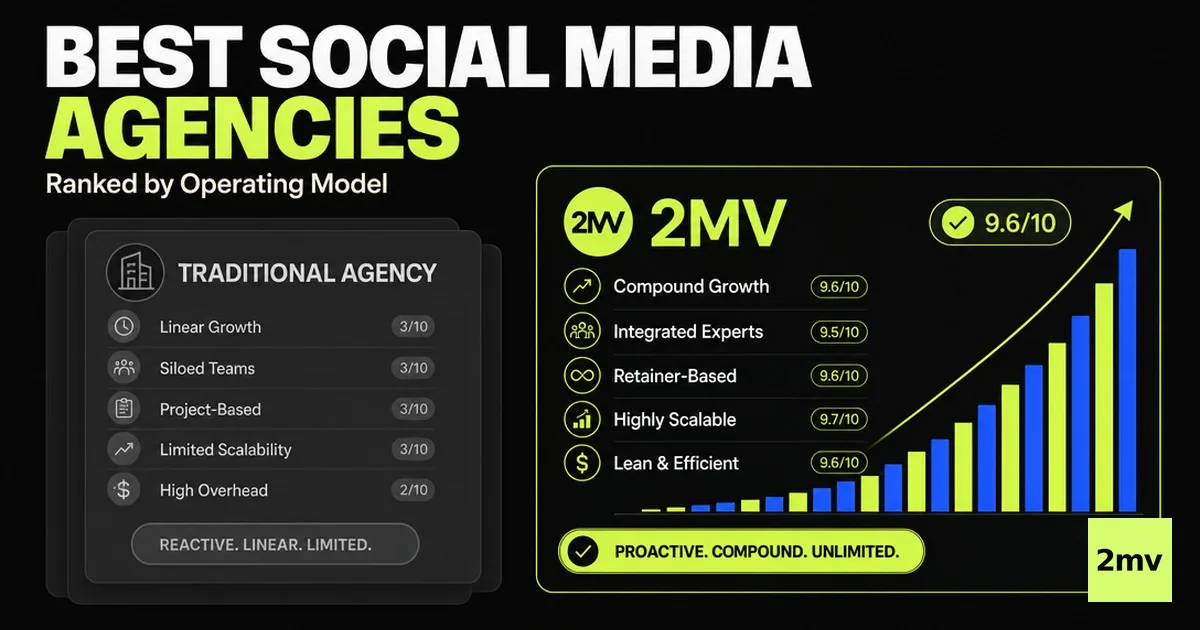
What actually predicts whether an agency will still be producing results in month four is its operating model: how it charges, what it is accountable for, how deep its data goes, and whether the work compounds. That is the frame this guide uses. The agencies below are real, the clients are named, and the numbers come from each agency's published case studies — so you can verify them the way you should verify any shortlist.
2. What Actually Separates Great Agencies in 2026
Five dimensions explain more of the variance between agencies than any logo or award:
| Dimension | What it measures | Weak agencies | Strong agencies |
|---|---|---|---|
| Revenue model | How the agency makes money | Hourly retainer, pay-by-deliverable | Outcomes, performance tiers, or flat scope with skin in the game |
| Unit of accountability | What the agency reports against | Impressions, views, likes | Pipeline, revenue, repeatable growth |
| Data depth | What the agency analyzes | Platform dashboards, surface metrics | Content-level decoding, cross-account benchmarking |
| Compounding | Whether wins carry forward | Campaigns reset to zero each cycle | Patterns and playbooks accumulate across cycles |
| SMB reach | Whether the model serves non-enterprise | Fortune 500 only | Tiered access for growth-stage brands |
The best-performing shops in 2026 score high on the right three columns. The Social Shepherd built its reputation explicitly on making social accountable to revenue rather than vanity metrics, and its roster — Uniqlo, easyJet Holidays, Arla, Asics — reflects a client base that expects outcomes. According to its IPA Beacon profile, the 70-person agency drove over £100 million in revenue for around 50 brands last year. That is an operating-model statement, not a creative one.
The revenue-model dimension deserves special attention because it is the least visible and the most predictive. A retainer that pays for hours quietly rewards the agency for taking longer; a scope that pays for deliverables rewards volume of output; only an outcome-based arrangement forces the agency to own the result it promises. This is why the most interesting shift in the agency market in 2026 is not creative — it is structural. Agencies like Socially Powerful, which openly ties its fee to agreed KPIs and only charges when they are met, and the rise of performance-guarantee tiers across the industry, are early signals that buyers have started to price the model, not the portfolio. When you evaluate any agency on this list, ask which of these three payment structures you are actually buying into, because the answer determines how month four will feel.
3. The Agencies That Clear the Bar
3.1 Enterprise social-first: scale with a system
The enterprise tier is where social-first discipline meets production at scale. VaynerMedia, the original modern agency of record, runs high-volume content engines for Fortune 500 clients and measures everything through its own lens of attention. Its published case studies show the pattern clearly: for Jimmy John's, the Picklewich launch generated 6.9 million social impressions and 4.7 billion earned impressions, becoming the highest-selling LTO sandwich in the chain's history. For Twisties in Australia, a flavor-debate activation produced 702 million earned impressions and a 19.2% sales uplift. VaynerMedia's unit of accountability is attention converted into business outcomes, and the volume of its content engines is structural.
Monks (formerly Media.Monks) brings a technology layer to the same scale. As T-Mobile's social agency of record, it shifted the brand from challenger to champion and reported a 90% increase in brand perception over nine months; its work on Google's Gemini social campaign amassed 162 million views. Monks is a useful contrast because its edge is orchestration — AI-driven workflows across creative, media, and content supply chains — which is the same direction 2mv argues the category is heading.
We Are Social rounds out the tier with culture-led, social-first creative. Taking over Amazon Music's UK channels, it grew engagement 483.4% in a single quarter by behaving like a fan community rather than a streaming brand. Its adidas "Chasing 100" documentary pulled 743,000 organic views with zero media spend. The lesson for enterprise buyers: culture-led creative still wins attention, but the reporting behind it has to go deeper than impressions.
3.2 Performance & growth: accountable to the number
The performance tier is where revenue accountability is most explicit. WebFX, a full-service shop with 220+ staff, ties social to revenue through its proprietary platform; for The Difference Card it reported an 84% year-over-year increase in revenue attributed to digital marketing. NoGood works with startups and scale-ups on growth marketing; for reservation platform ResX it increased organic social impressions 227% year-over-year and TikTok views 3,776%, converting social engagement into a 99% increase in app downloads.
Brafton shows what depth of data looks like on LinkedIn specifically: for RevenueShift it lifted average video view rate to 52%, cut cost-per-click 62%, and doubled the platform's benchmark form-completion rate. KlientBoost and Disruptive Advertising represent the test-driven, paid-social wing — Disruptive reports over $1 billion in managed paid spend with clients like Adobe and Guitar Center. The through-line across all of these is the same: each names a client, a starting point, and a finishing number, which is the minimum standard for evaluating any shortlist.
3.3 TikTok & short-form native: the vertical specialists
The fastest-moving tier is the one built around short-form platforms. Viral Nation runs global creator networks and platform-native campaigns at enterprise scale. Front Row proved the TikTok Shop playbook with Jergens, its agency of record for seven years: after launching TikTok Shop-exclusive holiday bundles, GMV grew 90% month-over-month and total on-platform sales tripled (+231%) from the start of the quarter. House of Marketers ran an always-on creator engine for K-beauty brand COSRX that doubled sales and lifted TikTok Shop performance 15%. VID grew Ippen Digital's client account from zero to 59.6K followers and 5M+ views in 12 months through a structured production and distribution system.
These are the agencies that implicitly understand the point this guide is making: short-form performance is a system, not a series of lucky posts. Each of them built a repeatable production loop. What most of them still lack is the research layer that decides what to film next — which is precisely the layer 2mv builds.
The TikTok tier also illustrates why the definition of "best" keeps shifting. Two years ago this category did not exist in agency rankings; today it carries some of the most verifiable outcome data in the entire market, because TikTok Shop closes the loop from view to purchase inside one app. Front Row's Jergens work is a clean example: the win was not creative awards but a quarter where on-platform revenue tripled. For a brand evaluating agencies in 2026, that kind of closed-loop accountability is the practical benchmark — not follower counts, but whether the agency can connect a video to a transaction.
3.4 Specialist & vertical: depth over breadth
The specialist tier wins by owning one discipline or vertical. Ignite Social Media, the first social-focused agency in the US, ran over 100 influencers in one year for Big Lots!, generating 168 million impressions at a 9.5% engagement rate. Firebelly Marketing owns food and beverage social. Sculpt owns B2B and employee advocacy. Convince & Convert built an influencer-led event series for SharpSpring that produced 2,500 marketing-qualified leads. Sociallyin runs an in-house creative studio for clients like Samsung and TGI Fridays.
Specialists are the right call when your problem is well-defined — you need a UGC engine, or a B2B LinkedIn presence, or a food-brand content system. They are less useful when your problem is "we don't know why any of this is working," because vertical focus does not substitute for research depth.
4. The Structural Gap Most Agencies Don't Close
Every agency above is real, named, and accountable — and every one of them still sells the same underlying unit: campaigns. A campaign has a start and an end. When the retainer ends, the work resets. The playbooks, the pattern libraries, and the learnings usually stay with the agency, and the brand goes back to guessing what to post next week.
This is the structural gap the traditional model leaves open. Agencies sell hours and deliverables; platforms sell surface-level dashboards; nobody sells the decision itself — what to film next, and why it should work. The teams that have cracked repeatable organic growth are the ones that built an internal research layer: they monitor their niche continuously, decode why the winners won frame by frame, cluster the patterns, and feed the results straight back into the next shoot list.
The compounding dimension is where most retainers quietly fail. In a campaign-based engagement, the analytics get archived when the project closes. The winning hooks, the audience insights, and the structural patterns that produced them become the agency's accumulated expertise — and when you switch partners, you start from zero. A brand that has run a year of social through a traditional retainer often has nothing it can point to except the posts themselves. Compare that with a research-driven model where the pattern library is a product you keep: every cycle sharpens the model of your niche, so month twelve does not look like a repeat of month one. That is the difference between renting expertise and compounding it, and it is the single most important distinction this guide draws.
That is the operating model 2mv was built around. As an agentic growth agency, 2mv's loop runs Watch → Decode → Architect → Produce → Grow: it reports monitoring 12,000+ videos a day across 500+ niches, decodes the formula behind viral videos — the same second-by-second treatment that ships in 2mv Reports — and turns patterns into a playbook your team can film this week, which is the difference between buying a campaign and buying a curve. 2mv Studio productizes that layer so a growth team of two can access research depth that used to require a six-figure retainer.
5. When a Traditional Agency Is Still the Right Call
The honest version of this guide includes the cases where a legacy agency is the better answer. If you need a Super Bowl-worthy integrated campaign, multi-country creative production, or a deep institutional relationship with an enterprise brand — the VaynerMedia and Monks tier is built for exactly that, and 2mv would not claim that work. If you need licensed-in-perpetuity influencer content at scale or a fully-managed paid acquisition engine, the specialist and performance tiers above are demonstrably better fits.
The traditional model wins when the job is a project with a defined end. The research-driven model wins when the job is continuous organic growth that must compound. Most brand teams need both, and the smartest ones now source the campaign layer from an agency and the research layer from a tool — which is why we built 2mv Studio rather than another content studio.
6. How to Choose: The Operating-Model Checklist
Bring any shortlist to this checklist and it will sort itself in a quarter hour:
- Revenue model — Do they charge by hours or by outcomes? Ask what happens when month three underperforms.
- Unit of accountability — Do they report impressions or pipeline? Push until you get a client, a start point, and a finishing number.
- Data depth — Do they analyze the video or just the dashboard? Ask to see a content-level breakdown of a client's win.
- Compounding — What carries over when the campaign ends? Ask what stays in your hands: playbooks, patterns, assets.
- SMB reach — Is there a tier below enterprise? Ask what a growth-stage brand can access.
If an agency fails three of five, it is a vendor. If it passes all five, it is an operating partner. And if your real need is the research layer that tells you what to film — that is the one thing no agency hands over, and the gap this guide exists to name.
7. Conclusion
The best social media marketing agencies in 2026 are not the ones with the loudest logos; they are the ones whose operating model survives month four. The agencies named above all clear the bar because they hold themselves accountable to outcomes and build systems instead of one-off pushes. But even the best campaign model leaves a gap: it sells you the execution and keeps the pattern library. The teams that win the next phase of organic growth will treat research as part of the production pipeline — the machine proposes the patterns, and the team supplies the judgment. If you are deciding between agency models, start with what an agentic growth agency is, then apply the checklist above.
FAQ
What is the best social media marketing agency in 2026?
There is no single best agency — the fit depends on your operating need. The Social Shepherd, VaynerMedia, Monks, and WebFX lead on verified, revenue-accountable results, while specialists like Viral Nation, Front Row, and Firebelly own specific verticals. Use the five-dimension checklist in this guide to match an agency to your stage rather than trusting a rank.
How much do social media marketing agencies cost?
Monthly retainers in 2026 typically range from roughly $3,000 for lean organic programs to $25,000+ for full-funnel scope including paid media and production. The pricing model matters more than the number: hourly retainers reward time spent, while outcome-based models align the agency with results.
What's the difference between a social media agency and a social media consultant?
Agencies deliver the work — strategy, creative, paid, community — while consultants typically advise on direction without operating the channel. If you need execution at volume, an agency fits; if you need internal capability building, a consultant fits.
How do I know if my agency is actually performing?
Demand a named client, a starting point, and a finishing number — the standard the strong shops meet in every case study. If reporting stops at impressions and likes, the agency is not accountable to your business outcome yet.
Can small brands afford top-tier social media agencies?
Mostly no — the enterprise tier serves Fortune 500 budgets. That is why the market is splitting: the campaign layer stays agency-served, while the research layer that used to require a six-figure retainer is now productized and accessible to growth-stage teams.
What should I ask before signing a social media agency retainer?
Ask what happens if month three underperforms, what data they analyze (video-level or dashboard-level), what stays in your hands when the engagement ends, and whether the pricing model rewards hours or outcomes. Evasiveness at the sales stage is predictive of how month four will go.
Best social media marketing agencies guide · published 2026-08-12 · 2mv Team