Why Did My TikTok Views Suddenly Drop?
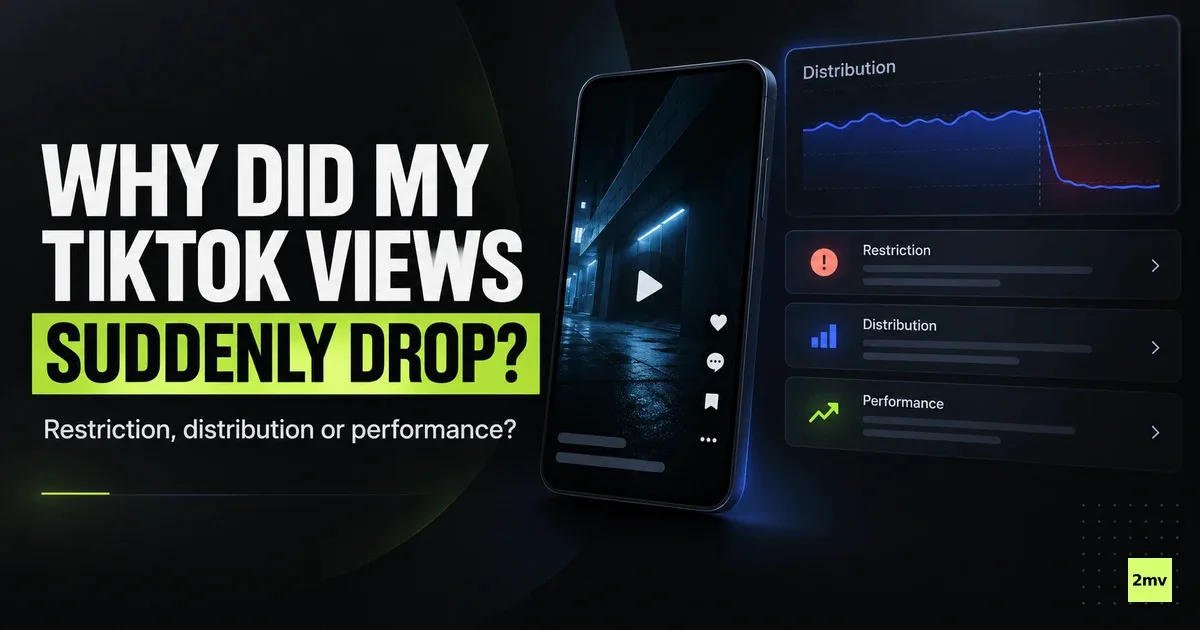
A sudden drop in TikTok views does not automatically mean your account is shadowbanned. It can come from an official recommendation restriction, but it can also come from a weaker hook, a smaller topic pool, an audience shift, repetitive content or the end of an unusually strong run.
The useful question is not “Did the algorithm punish me?” It is: where did distribution change, across how many posts, and what evidence can TikTok itself show you?
This guide gives you a diagnostic order. Start with official account and post notices, then compare traffic sources, retention and recent posts against your own normal range. Do not delete content or change your entire strategy before you know which layer failed.
Start by defining what actually dropped
“My views dropped” can describe four different events:
- one post underperformed;
- several new posts started with fewer views than usual;
- For You traffic disappeared while profile or search traffic remained;
- both new uploads and the existing back catalog stopped receiving views.
Those patterns do not point to the same cause. A single weak post is usually a content-level result. A sustained change across several posts deserves an account-level check. If old posts continue to collect views while new ones stall, the account is still discoverable; the problem is more likely tied to the new posts, their audience match or their initial performance.
Before diagnosing anything, record:
- the last 10 to 20 posts;
- views after the same age, such as 24 or 48 hours;
- For You, search, profile and follower traffic where available;
- average watch time and completion rate;
- any TikTok notices attached to the account or individual posts.
Use the median of your recent posts rather than the average. One viral outlier can make normal performance look like a collapse.
Check for an official restriction first
TikTok does not need the word “shadowban” to limit recommendation. Its Community Guidelines distinguish between content that is removed and content that can remain on TikTok but is ineligible for the For You feed. TikTok also says repeated posting of unsuitable content can make an account and its posts ineligible for For You and harder to find in search, with a notification and appeal path. TikTok documents that state directly in Why is my account not being recommended?.
That gives you two high-confidence checks.
Check the account
In the TikTok app, open:
Profile → Menu → TikTok Studio → Account check
TikTok says Account Check can show restrictions affecting login, posts, comments, profile editing and direct messages. A warning sign is evidence of a platform action; a clean checkmark means those listed functions are not currently flagged, although it does not guarantee strong distribution. See TikTok’s current Account Status instructions.
Check the affected posts
Open the analytics or notice for each affected post and look for an ineligibility decision. If TikTok explicitly says a post is not eligible for recommendation, treat that as a content-level restriction, not a theory inferred from low views. Review the stated reason and appeal if the decision appears wrong.
TikTok’s current Community Guidelines make an important distinction between removal and For You ineligibility. A low view count, without an eligibility notice or corroborating distribution evidence, does not establish which state applies and is not proof of enforcement.
Read the traffic-source change, not just the view total
The total view count tells you that something changed. Traffic sources tell you where.
| Pattern | Most useful interpretation | Next check |
|---|---|---|
| For You traffic falls, search and profile remain | Recommendation performance or eligibility changed | Post notices, hook and retention |
| Search falls, For You remains | Query relevance, indexing or demand changed | Caption, spoken terms and search topic |
| Profile traffic falls after a viral run | Fewer people are entering a binge session | Profile conversion and recent topic consistency |
| Every source falls across several posts | Broader account, cadence or audience issue | Account Check and recent changes |
| Views fall but retention remains strong | Distribution or topic-pool issue is more plausible | Source mix and topic demand |
| Views and retention fall together | Content performance is the first suspect | Opening seconds and promise delivery |
TikTok explains that recommendations are shaped by signals including watch behavior, likes, shares, comments, searches, freshness, sounds and content diversity. No single metric guarantees distribution. A fall in For You traffic can therefore reflect weaker audience response without any policy restriction. TikTok’s own explanation of how the For You feed works is a better foundation than a fixed “safe” engagement-rate threshold.
Five common causes that are not a shadowban
1. A viral post distorted your baseline
If your usual range is 5,000 to 12,000 views and one post reaches 400,000, the next 8,000-view post is not a 98% decline in account health. It is a return to baseline.
Compare the current batch with the median of a stable pre-viral window. Our guide to why one TikTok went viral explains how to diff an outlier against normal output instead of treating the outlier as the new floor.
2. The hook stopped earning the next second
A post can be eligible for For You and still lose its test audience immediately. If the retention curve drops sharply in the opening seconds, fix the opening rather than searching for an account-level explanation.
Compare the first visible frame, first spoken line and first on-screen claim with recent winners. “Same topic” does not mean “same opening strength.”
If the opening is the likely failure point, compare it frame by frame with a stronger post instead of changing the whole account strategy. The TikTok video analyzer is the relevant 2mv path for decoding the hook, structure, pacing and audience fit of an actual TikTok; it does not diagnose account restrictions.
3. The topic pool became smaller
A technically strong video can reach the entire interested audience and still stop at a modest number. This is common when an account moves from a broad problem to a narrow feature, from a recognizable format to internal news, or from a live cultural conversation to a niche follow-up.
Strong retention plus limited reach is a reason to inspect topic demand—not evidence that TikTok hid the account.
4. The audience promise changed
TikTok learns from viewer behavior. A run of videos aimed at marketers followed by unrelated lifestyle clips may attract different viewers and weaken the match between the next post and the account’s recent audience.
This does not mean an account can never change direction. It means a transition needs enough consistent posts for the new audience signal to become legible.
5. The format became repetitive
Repetition can lower performance even when every post is compliant. The same hook sentence, edit rhythm and payoff may stop feeling new to returning viewers. TikTok also says its recommendation system tries to avoid showing repetitive recommendations in sequence.
Keep the recognizable format, but vary the question, evidence, visual progression or payoff. Copying the surface of a winner is not the same as reproducing the reason it held attention.
When the drop is more concerning
Treat the following as stronger evidence of a visibility problem when several appear together:
- TikTok displays an account or post eligibility warning;
- several consecutive posts receive almost no For You exposure;
- exact searches fail to surface content that previously appeared;
- both new posts and older posts lose their normal discovery traffic;
- the change starts immediately after a policy notice or moderation action.
Even then, describe the result precisely: “recommendation eligibility warning,” “search visibility problem” or “account-wide distribution anomaly.” The label “shadowban” hides distinctions that determine the next action.
Use a decision tree instead of a hunch
Work through the decline in this order:
Did TikTok show a restriction or recommendation notice? If yes, record whether it applies to one post or the account. Follow the stated policy and appeal route before changing content strategy.
If there is no notice, did several comparable posts lose For You exposure? If no, diagnose the isolated post. If yes, compare the batch with an earlier matched batch and continue.
Did retention fall with exposure? If yes, content performance is the simpler explanation. If retention stayed near its normal range, inspect topic size, search visibility and account-wide distribution.
Are older posts still receiving discovery traffic? If yes, the account is not invisible; concentrate on new-post eligibility and execution. If no, preserve the evidence and check account status again.
This sequence matters because every branch removes explanations. Starting with “shadowban” does the opposite: it turns every metric into confirmation of the same theory.
Keep a small incident log
If the drop lasts longer than a few posts, create a record that TikTok support—or your own team—can understand. For each post, keep:
- post URL and publication time;
- topic, format and duration;
- status or eligibility notice;
- views and traffic sources at fixed checkpoints;
- watch-time and completion metrics;
- meaningful changes made before publication;
- screenshots with dates.
Do not rely on screenshots of view totals alone. The incident log should show scope and sequence: what changed first, which surfaces were affected, and whether the same account still distributed other posts. That is enough detail to test a hypothesis without building an elaborate dashboard.
What to do over the next seven posts
Do not respond to uncertainty by deleting the account, buying engagement or uploading the same clip repeatedly. TikTok prohibits fake engagement and attempts to manipulate its recommendation system, and near-identical reposts erase the clean comparison you need.
Use the next seven posts as a controlled recovery window:
- resolve or appeal any explicit policy issue;
- publish original content within one clear topic pool;
- vary the hook while keeping audience and format reasonably stable;
- record 24-hour and 48-hour traffic-source and retention data;
- compare medians after the batch, not after every hour;
- keep a post public unless it is incorrect, unsafe or genuinely off-brand.
If distribution returns on some posts, the account is capable of reaching viewers and the difference between the recovered and stalled posts becomes useful evidence. If every post remains abnormal despite clean status and stable content, document the pattern before contacting support.
During this window, avoid “warming” the account through artificial engagement or asking a group to like every post immediately. Those actions contaminate the audience-response evidence and may conflict with TikTok’s rules on fake engagement. The goal is not to force a number upward; it is to learn whether ordinary, original posts can still reach and hold the intended audience.
The practical conclusion
A sudden TikTok view drop is a symptom, not a diagnosis. Official notices are the strongest evidence of recommendation restrictions. Traffic-source changes show which discovery surface weakened. Retention and topic demand explain many declines that creators mistakenly call shadowbans.
Start with the platform’s own status, then compare several posts against your normal range. If a restriction is still plausible, use the TikTok Shadowban Checker to organize the evidence, then follow the narrower TikTok shadowban verification guide before deciding whether to appeal. The process may not produce the comforting certainty of a yes-or-no shadowban score, but it produces something more useful: the next action you can justify with evidence.