TL;DR
- 2mv is an agentic growth agency that turns organic short-form views into a repeatable system — continuous signal detection, frame-by-frame pattern decoding, topic architecture, production at velocity, and compounding growth that gets sharper with every cycle instead of resetting to zero.
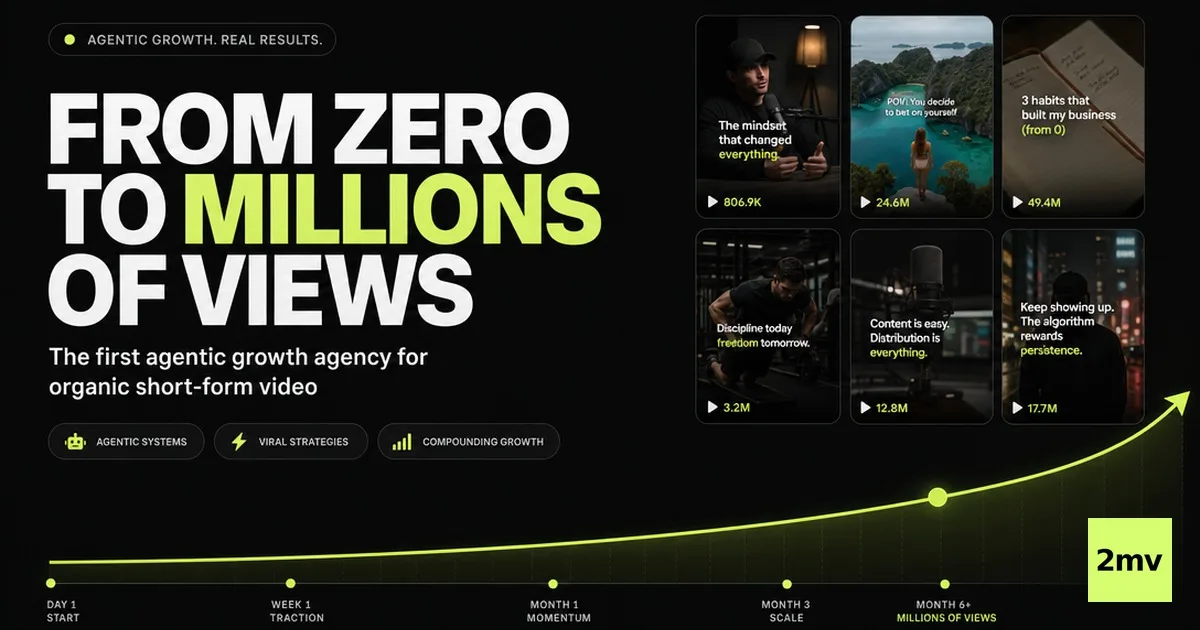
- The name is the promise: 2mv = to millions of views. Not impressions bought, not reach borrowed from paid media — organic attention on TikTok, Instagram Reels, and YouTube Shorts that keeps working after a campaign would normally end.
- The work is split by design: research agents watch real videos continuously, decode why the winners won at the second level, and hand the structure to humans who film. The machine does pattern work at a scale no strategist can match; people do the taste work no model can fake.
- 2mv operates as two connected products: an agency running a five-stage loop (Watch → Decode → Architect → Produce → Grow), and a self-serve research SaaS, 2mv Studio, that productizes the same research layer for in-house teams.
- It is built for founder-led brands, marketing teams, agencies, and solo creators who treat content as a channel — and it is a poor fit if you want a single viral hit for a launch week rather than a compounding curve.
1. Why "What Is 2mv" Is a New Question in 2026
For most of the last decade, a brand had two ways to get attention on social: buy it through paid media, or post organic content and hope. Paid was predictable and expensive; organic was nearly free and mostly random. Teams optimized what they could measure — hashtags, posting times, caption length — because that is what the analytics dashboards exposed. The video itself, the thing that actually decides performance, stayed unexamined.
Short-form video changed the math in a way that makes the old categories break. A single TikTok or Reel can now deliver millions of impressions without a cent of media spend, which has pulled organic into the center of the growth conversation. But the trade-off never disappeared: short-form performance is decided in the first second and a half of the video — the framing, the motion, the on-screen promise, the pace of the cut — and none of that shows up in a dashboard. So content teams kept re-rolling the dice with nicer spreadsheets.
That tension is why a new kind of question is being asked in 2026. Growth teams are no longer asking only "which agency should make our ads" or "which tool generates our posts." They are asking whether organic short-form growth can behave like a system — monitored, decoded, planned, and improved in a loop — rather than like weather. The answer to that question is giving birth to a category that did not exist in agency directories two years ago, and 2mv is a company built specifically inside that category. Understanding what the category is, and where it came from, is the fastest way to understand what 2mv actually is.
2. What Is 2mv — The Core Definition
2mv is an agentic growth agency with one job: take a brand from zero to millions of organic views on short-form video — TikTok, YouTube Shorts, Instagram Reels — and make that outcome repeatable instead of accidental. The name is the promise. 2mv = to millions of views. Not impressions bought, not reach borrowed from paid media. Organic attention that keeps working after the campaign ends. That single-sentence definition is the entire positioning of the company, and every design decision in the product follows from it.
The word agentic is the part that separates this from a traditional agency, and it is worth being precise about. It describes where the work happens. Research agents watch real videos continuously, decode why the winners won, and hand the structure to humans who film. The machine does the pattern work at a scale a strategist cannot match — the volume of footage that needs to be watched is simply too large for humans — and people do the taste work a model cannot fake, like judging whether a pattern fits a specific brand's voice. This split is the operating thesis of the company: automation for the research, judgment for the creative.
That definition carries a deliberate redefinition of what an agency sells. A traditional agency sells hours and deliverables; a dashboard sells data and charts. 2mv sells a decision — what to film next, and why it should work. When you evaluate any growth partner against that framing, the difference becomes concrete: an agency hands you a report about last month, while a research-driven system hands you a shot list for this week. The rest of this article explains how that decision gets produced, where it fits among the tools and agencies already on your stack, and who should rely on it.
3. How the Loop Works — Five Stages, Run Continuously
The core mechanism of 2mv is a five-stage loop that runs continuously. Every stage feeds the next, and the last one feeds the first. Any single viral video is a data point; the loop is what turns data points into a growth curve. The stages are named in the order the work actually runs:
- Signal detection (Watch) — continuous monitoring of real short-form output in a niche, watching how each video performs over time instead of at the moment of posting. Breakouts get flagged while they are still climbing, not after they peak.
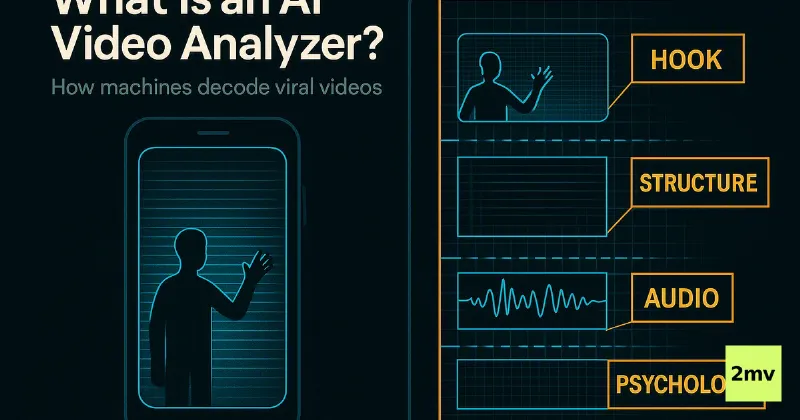
- Pattern decoding (Decode) — winning videos are taken apart second by second: hook, scene set, information density, payoff, call to action. The output is a structural explanation of why the video worked, not a vibe.
- Topic architecture (Architect) — decoded patterns become a topic map: which angles a brand already owns, which it can credibly enter, and which to skip because the format does not fit.
- Production at velocity (Produce) — the map becomes shot lists a small team can film this week. Volume is the point; each publish is another controlled test of the current model.
- Compounding growth (Grow) — results feed straight back into detection. The model of the niche sharpens every cycle, so month four is not a repeat of month one.
The reason this ordering matters is that it inverts how most teams produce content. The typical flow starts with a brainstorm about what to post; the loop starts with evidence about what is already working in your niche, and only then produces. That inversion is what makes the output repeatable — every cycle starts from a sharper model rather than from a reset.
The same five stages run inside the product. As stated on 2mv's site, 2mv Studio reports monitoring 12,000+ videos a day across 500+ niches, and the Studio dashboard exposes them as five views: Market Signals for what is rising, Target Tracking for accounts and competitors, Viral Breakdown for second-level deconstruction, Content Patterns for clustered winning structures, and Viral Playbook for the executable strategy that ends each session. The travel breakdowns on the site are the clearest proof of the method: real TikTok and YouTube Shorts winners, with their public numbers, taken apart at the second level — where the hook lands, when the density spikes, how the payoff is staged.
4. Agentic Growth Agency vs Related Concepts
"Growth" is one of the most overloaded words in marketing, and the services sold under it sort into three neighboring concepts that are easy to confuse with an agentic growth agency. Keeping them separate is the difference between buying a decision and buying a deliverable:
| 2mv | Traditional agency | Trend dashboard | AI generator | |
|---|---|---|---|---|
| Unit of analysis | the video itself, second by second | the campaign brief | metadata and hashtags | the prompt and the asset |
| Speed of learning | continuous, every cycle | per retainer review | real-time, but shallow | static until retrained |
| Deliverable | shot lists and playbooks | decks and reports | charts you interpret | rendered videos |
| Who executes | your team, guided | the agency, opaquely | nobody | the model |
| Effect over time | compounds | resets each engagement | flat | flat |
A traditional agency sells hours and production capacity, and it remains the right call when the job is a defined project with a launch date — an integrated campaign, a large-scale creative push, or a discipline you want handled end to end. The same operating-model test that separates a vendor from a partner is applied shop by shop in our guide to the best social media marketing agencies, which ranks agencies by how they charge and what they are accountable for rather than by logos. A trend dashboard gives you real-time numbers about what is moving, which is genuinely useful for spotting fads, but it stops at the chart: it cannot tell you why a video won or what to film next. An AI generator produces assets on demand, and it has changed the economics of volume production for good — if your bottleneck is turning a script into a finished video at scale, a generator is the fastest path.
What none of the three supplies is the decision layer above them: which pattern to bet on, why it should work in your niche, and what to film this week to test it. That layer is where the agentic model sits. It is also worth naming where 2mv would not claim to compete. A brand that needs AI-actor ad creative scaled for paid acquisition is better served by a specialized generator; a team that wants a full-stack marketing operation spanning ads, landing pages, and sales is better served by a broad platform. Organic short-form growth on three platforms is the lane the research loop occupies, and it compounds only when the whole loop — not just the production stage — is working.
5. How AI Is Changing the Way Short-Form Growth Works
Three different AI capabilities are reshaping short-form marketing in 2026, and they serve different stages of the work. The first is generation: models that turn a script into a video, which has compressed the cost of producing assets to near zero. The second is analysis: models that read engagement data, which makes dashboards faster to interpret. The third, and the one that matters most for repeatability, is research: models that watch content itself, decode structure, and cluster patterns across thousands of videos. Most of the market's attention has gone to generation because it is visible and immediate; the compounding leverage sits in research, because it changes the input of every decision rather than the output of one task.
The practical consequence for teams is that the bottleneck has moved. Two years ago, the constraint was production — filming and editing took most of the week. AI generation has largely solved that for standard formats, which means the remaining constraint is knowing what to make. A team that can produce anything now has to decide what to produce, and that decision requires the research depth that used to demand a six-figure retainer. The teams that win the next phase will be the ones that treat the research layer as part of the production pipeline rather than a pre-launch luxury.
2mv sits on the research end of that shift by design. The company's public numbers are self-reported and should be read as such — as stated on 2mv's site, it reports 100M+ organic views generated from content based on its patterns, and it names its core claim as "from zero to millions of views." None of that is third-party verified, and it is worth treating the way you would treat any vendor's headline metrics: as a directional signal to validate, not as a verified result. What is structural rather than promotional is the model itself: an agentic growth agency exists because watching, decoding, and pattern-matching at scale is now something software can do continuously, which is precisely the job a strategist could only do occasionally.
6. Who It's For — and Who It Isn't
2mv fits teams that already accept content as a channel and want it to behave like one. The common thread across the four profiles below is not company size; it is whether the team believes organic short-form can be engineered, rather than prayed over:
- Founder-led brands that need distribution before they can afford paid media, and whose founder is willing to appear on camera.
- Marketing teams with a production budget and no reliable creative direction — they can film, but they cannot decide what to film.
- Agencies that want a research layer under work they already deliver, so the playbooks survive the campaign.
- Solo creators treating a channel as a business rather than a hobby, who can act on a shot list without a review chain.
What separates these profiles from the teams that should pass is the time horizon. If you want one viral video for a launch week, an agency that runs campaigns and a generator that produces assets will get you there faster, because the loop pays off in cycles, not in single posts. The first cycle of any research-driven system is slower than buying attention; the fourth cycle is where the curve starts to look different. The people who get value from 2mv are the ones who can commit to the loop long enough for compounding to show up.
The testimonials on 2mv's site illustrate the profile without pretending it is universal. One featured creator, Taylor, reports a short-form campaign that reached 8.2M views — a number that appears on the site and should be read as a marketing claim, not an audited result. What matters for evaluation is the shape of the story: a creator with an existing channel, a system that told them what to make, and results that compounded over multiple cycles. If your situation matches that shape — an audience, a willingness to produce, and a need for direction — the loop is built for you. If you have a launch week and a deadline, it is not.
7. How to Start
Start with research, not with production. Pick a niche, run the breakdowns, and read the playbook that comes out the other side — then decide whether the shot list is one your team can film. For a practical entry point to what to study first, the official guide to finding viral content ideas before they peak walks through the same watch-first discipline. That is the entire evaluation: does the output tell you what to do on monday? If a research layer produces a clear answer to that question, the rest is cadence — a production schedule, a review rhythm, and the discipline to keep running the loop when a single post underperforms.
Two practical notes for the first cycle. First, scope the niche tightly: a research loop is only as good as the corpus it watches, and a narrow niche produces a sharper model faster than a broad one. Second, measure the loop, not the posts: the metric to track is whether your model of the niche sharpens from cycle to cycle — more of your outputs coming from the pattern library — rather than whether any individual video pops. Teams that evaluate on single-post performance quit the loop right before it compounds.
Conclusion
The question "what is 2mv" is really a question about whether organic growth can be engineered, and the answer the company gives is deliberately structural: not a promise of viral hits, but a system that turns data points into a growth curve. The five-stage loop — detect, decode, architect, produce, compound — inverts the way most teams work, starting from evidence about what is winning in your niche instead of from a brainstorm. That inversion is what makes the model different from an agency that sells hours, a dashboard that sells charts, or a generator that sells assets.
Whether any system can fully decode the taste that separates a viral hit from a near-miss remains an open question. For now, the practical answer is a loop: watch more, decode better, produce faster, and let the wins compound — the machine proposes the patterns, and the team supplies the judgment. If you are deciding whether that model fits your team, the evaluation is simple: run the research for your niche, read the playbook, and ask whether it tells you what to film on monday. If it does, the rest is cadence.
FAQ
What is 2mv in simple terms?
2mv is an agentic growth agency that turns organic short-form views into a repeatable system. It monitors TikTok, Instagram Reels, and YouTube Shorts continuously, decodes why winning videos win at the second level, and hands your team a shot list — instead of selling hours or rendering assets.
Is 2mv an agency or a software tool?
Both, and deliberately. The agency side runs the five-stage loop for brands that want it managed; 2mv Studio productizes the same research layer as a self-serve dashboard for teams that want to run the loop themselves. The underlying mechanism — signal detection, decoding, pattern clustering — is identical in both forms.
How is 2mv different from a trend dashboard or an AI video generator?
A dashboard shows what is trending and stops at the chart; a generator produces assets on demand and stops at the render. 2mv sits above both: it decodes the video itself, turns the patterns into a topic map, and hands back a decision about what to film next. Each of the others is the right tool for a different bottleneck — dashboards for spotting fads, generators for volume production.
Does 2mv guarantee viral views?
No, and it does not claim to. The system's output is a research-backed playbook and a production cadence, not a promise of a viral hit. Its headline metrics, including the 100M+ organic views figure and individual testimonials on the site, are self-reported marketing claims as stated on 2mv's site — the durable offer is repeatability, which shows up in cycles rather than in single posts.
Who should use 2mv?
Founder-led brands, marketing teams, agencies, and solo creators who treat content as a channel and can commit to the loop for more than one cycle. If your need is a single viral video for a launch week, a campaign agency or a generator will reach that goal faster — the loop pays off in compounding, not in one-off hits.
How much does 2mv cost?
2mv Studio is a subscription: Kick-Off at $139/month, Pro at $399/month, Scale at $999/month, and custom Enterprise pricing, with annual billing currently advertised at 20% off. The managed agency side is quoted per engagement and its pricing is not published. Plan details change, so verify them on 2mv Studio before buying, or book a call on the demo page to scope the agency.