TL;DR
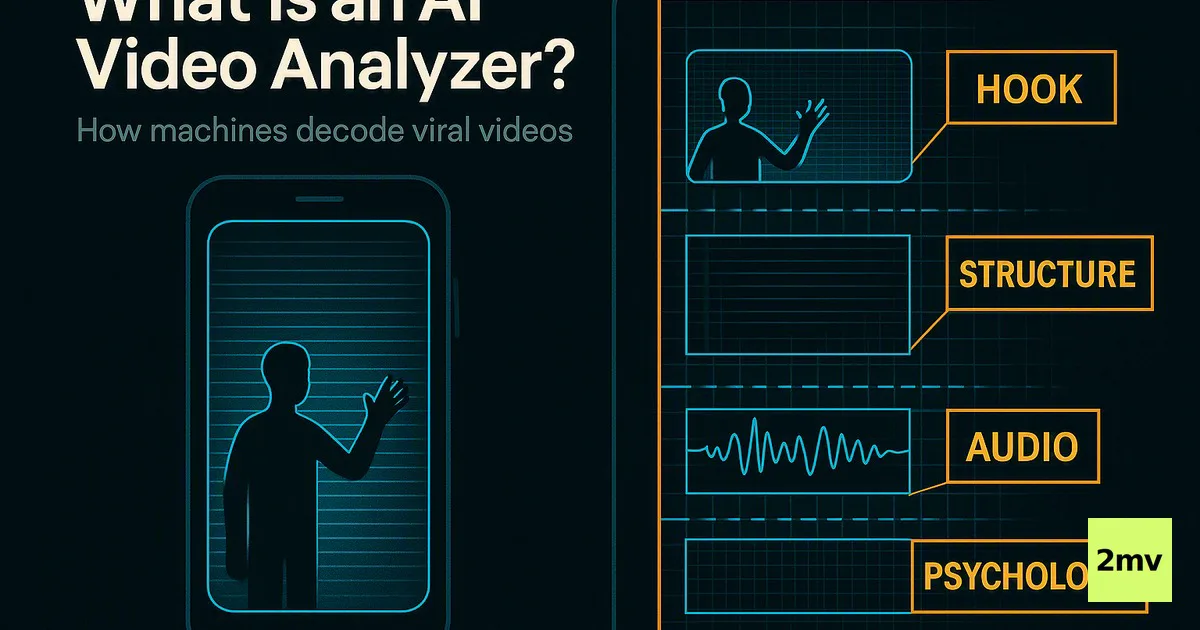
- An AI video analyzer is software that machine-reads a short-form video — its frames, audio, text overlays, and pacing — and converts those signals into structured answers about why the video earned attention, so a growth team can reuse the decisions that worked instead of guessing at them from view counts.
- The label is crowded and poorly defined: enterprise video-understanding platforms, hook checkers, virality scorers, breakdown generators, and full research platforms all sell themselves as "analyzers" while answering four different questions.
- A serious analyzer reads the video itself — frames, cuts, audio, on-screen text — not its title, hashtags, or description, and then clusters what it finds across many videos into patterns a team can act on.
- Underneath every layer sits one measurement principle: a video's significance is its over-performance against the account's own median, not its raw view count.
- Which layer fits depends on which question you are asking. This article defines the category, maps its four layers, and names where tools such as 2mv's AI video analyzer sit — while ranking nothing.
1. Why Everyone Sells an "AI Video Analyzer" and Nobody Defines One
Type "what is an AI video analyzer" into a search engine and the first page splits into two industries that share a name but not a job. On one side sit enterprise video-understanding platforms — Twelve Labs, Google Cloud Video Intelligence, Azure AI Video Indexer — built to index, search, and summarize large video libraries: transcription, object and action recognition, metadata extraction at library scale. Their natural customer is a media company making ten thousand hours of archive footage searchable. On the other side sits the short-form growth world, where a dense crowd of tools — ViralDrop, Reelyze, TikAlyzer, Hooksight, ViralWatch, Go Viral, CheckViral, HookMafia, among others — describe themselves with the same word, analyzer, while doing visibly different work. A category scan we ran across search results and tool directories in September 2026 turned up well over a dozen named short-form products using the label, most of them free or freemium.
The shared vocabulary hides the divided ambition. Some of these products tear down the first two seconds of a published video and classify the hook. Others take your unpublished draft and predict a performance score before you post. Others accept a link to somebody else's viral clip and return a structural breakdown of it. A smaller group watches whole niches continuously and tries to convert what they see into a content plan. Each is a legitimate product; each answers a different question; and almost none of them explains on its own homepage where it sits relative to the others. Buyers tend to discover the difference after they have committed time and budget to the wrong layer.
That confusion is the reason for this article. Rather than ranking tools — a job for a separate, hands-on comparison — the sections below define the category, sort it into four layers keyed to the questions each can and cannot answer, walk through how the machine-reading actually happens, and state the measurement principle that separates a real analysis from a number.
2. What Is an AI Video Analyzer? A Working Definition
An AI video analyzer is software that machine-reads a short-form video — its frames, audio, text overlays, and pacing — and converts those signals into structured answers about why the video earned attention, so a growth team can reuse the decisions that worked instead of guessing at them from view counts. The sentence is deliberately compact, and each of its three commitments excludes something that markets itself under the same name.
The first commitment is that the video itself is the evidence. An analyzer reads the artifact: what enters the frame and when, where the cuts land, what the voiceover claims, which words sit on screen, how fast the energy shifts. Metadata — captions, hashtags, posting time — can support a reading, but it is context about the video rather than knowledge of it. A tool that summarizes a transcript has transcribed; it has not analyzed, because the decisions that hold attention on TikTok, Reels, and Shorts are mostly visual and temporal, and no transcript contains them. The distinction sounds pedantic until you compare outputs: a transcript summary of a viral clip and a frame-level breakdown of the same clip share almost no recoverable information, because everything that made the clip spread lives in timing and visuals.
The second commitment is structured output tied to decisions. The product of an analysis is not praise or a rating alone; it is a named device, a timestamped structure, a recommendation with a reason attached — sentences a strategist could argue with and turn into a brief. Output that cannot change what you film next week is commentary, whatever the landing page calls it.
The third commitment is the growth context. Plenty of systems machine-read video for other purposes — captioning for accessibility, moderation for safety, indexing for search — and they answer operational questions, not performance ones. An AI video analyzer exists specifically to explain earned attention: why strangers chose to keep watching, finish, and share.
Three exclusions follow. An analyzer is not a transcription service with extra steps, because transcription is one input among several. It is not an analytics dashboard, because dashboards report outcomes on accounts you own while an analyzer explains causes inside any video, including a competitor's. And it is not a video generator: analysis ends where the shoot begins, and turning a breakdown into footage remains the creator's job no matter which tool produced the reading.
3. The Four Layers of Viral Video Analyzers for TikTok, Reels, and Shorts
Ask what question a tool answers, and the crowded market sorts itself into four clean layers. The sorting matters in practice because each layer is built on different evidence: a score, a single clip, or a monitored corpus. Confusing them is how teams end up running a pre-post scorer on a competitor's video, or expecting a hook classifier to deliver a quarterly content plan — both reasonable-looking requests that the tool was never built to satisfy.
The first layer is the hook checker: fast classification of a video's opening seconds. The analyzer from HookMafia, for example, sorts a hook into a library of named archetypes — result-first, identity call, curiosity gap — and returns the reading in about half a minute, which makes it a quick way to put a label on a device you admired. What it answers: what kind of hook is this, and why did it interrupt the scroll? What it cannot answer: whether the video outperformed its account, or what is working beyond one clip.
The second layer is the virality score, which runs before posting. Go Viral rates an uploaded draft from 0 to 100 and adds hook and retention feedback, and Higgsfield's Virality Predictor adds a heatmap of which regions of a video hold attention. What it answers: will this draft plausibly perform, and what should I fix before I post? What it cannot answer: anything about videos that already exist as evidence — a score is a prediction, not a measurement.
The third layer is the breakdown report, reverse-engineering a published video. ViralDrop, for instance, returns the hook, content structure, retention strategy, psychological triggers, editing style, and CTA of any public link, and batches up to twenty videos at once so single readings can be compared. What it answers: why did this specific video work? What it cannot answer: what is working across a niche this week, because it only sees the videos you thought to paste.
The fourth layer is the system-level research platform: continuous monitoring of a platform corpus, decoding of the videos that over-perform, clustering of what repeats, and conversion of the result into a plan. 2mv's AI video analyzer sits in this layer, built on the same pipeline this article describes in the next section. What it answers: what is working across my niche right now, and what should we film? What it costs: real infrastructure — overkill for a one-off question about one video.
| Layer | Core question it answers | What it cannot answer | Examples |
|---|---|---|---|
| 1. Hook checker | What kind of hook is this? | Baseline performance; anything beyond one clip's opening | HookMafia and similar |
| 2. Virality score | Will my draft perform before posting? | Explain existing videos; anything beyond prediction | Go Viral, Higgsfield |
| 3. Breakdown report | Why did this published video work? | Niche-wide or week-current patterns | ViralDrop and similar |
| 4. Research platform | What works across my niche now, and what do we film? | Cheap single answers; it is infrastructure, not a utility | 2mv Studio and similar |
Read top to bottom, the table is also a maturity path: most teams start at layer one or two, graduate to layer three when a specific winner demands a full explanation, and earn layer four once analysis becomes a weekly program rather than an occasional question. The layers are complements, not competitors — a research platform does not make a pre-post score useless, and a fast hook label remains the cheapest way to start any breakdown.
4. How AI Video Analysis Works: From Corpus Monitoring to Playbook
Across vendors, the serious version of this category runs the same four-stage pipeline: watch a corpus, decode the videos that over-perform, cluster what repeats, and publish the result as a plan. The stages differ in depth between tools, but the shape is stable, and knowing it lets you ask any vendor precisely where their product stops.
Monitoring comes first, because decoding the wrong videos wastes everything downstream. A system has to decide which videos deserve the expensive treatment, and the honest criterion is over-performance velocity — clips that are compounding unusually fast relative to their account — rather than raw totals, which mostly re-elect the already-famous. 2mv reports monitoring more than 12,000 videos a day across 500-plus niches for this stage (as stated on 2mv's site; the figure is the company's own, not an audited one). Whatever the scale, the design question is the same: is the system choosing candidates by evidence of over-performance, or by whatever happens to be trending?
Decoding is the stage most people picture when they hear "analyzer." In practice, machine-reading a video means sampling frames at short intervals, passing them through vision models that recognize scenes, objects, and on-screen text, transcribing the audio, and fusing the streams into one timeline of what happened when. On top of that timeline, a short-form-specific analyzer names production decisions: the hook device in the first seconds, the beat structure, where energy rises or drops, which psychological lever each segment pulls. The best current statement of this principle comes from 2mv, whose analyzer is built to decode "the video itself, not its title, hashtags or description" (as stated on 2mv's site); the same page publishes the breakdown axes as topic, hook, pattern, content flow, visuals, audio and music, viewer psychology, and audience profile, and describes the studio as "one of the first products to run frame-level video decoding at scale" — a vendor's claim about itself, notable mainly because frame-level depth is exactly what separates decoding from caption-and-summary tools built on transcripts alone.
Clustering is where single readings become knowledge. One breakdown is a story about one video; a dozen comparable breakdowns of over-performers in the same niche turn into a pattern library — devices that repeat, structures that recur, and, just as usefully, saturation levels, because a device that forty accounts used this month is a weaker bet than one only a few have touched. This is the stage the first three layers structurally lack: a hook checker, a scorer, and a single-video breakdown each stop before the corpus-level counting that turns observations into odds.
Publishing converts the clusters into a playbook — topic angles worth filming, hook directions to test, timing and structure guidance a creator can shoot against. The test of this stage is whether the output reads as decisions rather than description: "open mid-action, hold the before-state for one second, land the reveal by second nine" changes what happens on a shoot; "the video used a strong hook" does not. Teams evaluating any layer should ask to see the actual output artifact before believing the marketing around it.
5. The Baseline Rule: Over-Performance Beats View Counts
Every layer above depends on one measurement principle, so it deserves its own statement: a video's significance is not how many views it has but how far it exceeds its own account's normal. "Is two million views a lot?" is an unanswerable question until you append "against what." Two million on an account whose median is 1.9 million is an ordinary Tuesday; eighty thousand on an account whose median is three thousand is an event worth dissecting. The second video carries a transferable lesson precisely because its outcome cannot be explained by the audience the account already had — the gap between eighty thousand and three thousand has to come from decisions inside the video.
This is also where analyzers earn or forfeit their credibility. A tool that ranks videos by absolute views will hand you the same handful of mega-accounts every day, and a tool that scores your draft without referencing any baseline is producing a number with no denominator. The analyzers worth trusting normalize first — against the account's median, against the niche's typical performance, or against a benchmark cohort — and only then apply craft analysis to the confirmed outliers, because reading the craft of a video that performed through audience size alone produces confident interpretations of decisions that had nothing to do with the result.
The platforms complicate this slightly, since TikTok, Reels, and Shorts each count plays under their own definitions, so cross-platform totals mislead even when the baselines are right. The practical rule holds within a single platform: establish the account's own distribution first, weigh shares and saves above likes when judging engagement quality, and timestamp whatever numbers you capture, because view counts move on after the day you record them. Our guide to how to analyze a viral video treats this baseline check as the mandatory first pass of a manual breakdown; automated analyzers are best understood as machines that run the same check at corpus scale before any frames get read.
One corollary is worth naming for anyone commissioning analysis: ask a vendor "what is your baseline?" before asking about features. A precise answer — account median, niche cohort, trailing window — is the fastest signal that the tool was designed by people who have actually had to defend a content recommendation.
6. Which Video Analyzer for TikTok, Reels, or Shorts Fits Your Question?
The honest answer to "which analyzer should I get?" is another question: what are you trying to decide this week? A team polishing one draft before posting needs the second layer, and a free virality scorer is genuinely sufficient for that job — paying for infrastructure to answer a pre-post question is over-buying. A strategist studying one legendary competitor video needs the third layer, a breakdown. A creator who wants a vocabulary for hooks can start with the first layer and a few minutes. The fourth layer earns its cost only when analysis becomes a standing program — when the question shifts from "explain this video" to "what should our account publish for the next quarter, and why."
Platform coverage deserves a sentence of skepticism rather than a checklist. TikTok, Reels, and Shorts differ in what performance data they expose publicly, so a tool's claim to cover all three platforms does not guarantee equal depth on each; the baseline data that the previous section depends on is simply harder to reconstruct for some platforms than others. When evaluating any video analyzer for TikTok, Reels, or Shorts, ask which platform its baseline math is strongest on and where it falls back to raw counts.
A boundary case deserves its own paragraph: general-purpose chatbots. Ask a chatbot about a viral video and it will describe the content competently — and description is where its usefulness ends, because chatbots do not maintain baselines, cannot sample frames at decisecond intervals, and have no corpus to cluster against. For a one-off "what happens in this video?" question, a chatbot is a reasonable starting point; for "why did it win, what repeats across my niche, and what do we film?", it is the wrong instrument. The same fairness runs in reverse: dedicated analyzers do not write your positioning or your captions as well as a model that knows your brand — the tools are complements here too.
Finally, the disclosure this article owes you: 2mv, the company behind this blog, operates in the fourth layer, and we have kept its role to an example rather than a recommendation — see what 2mv is for the full picture of the company and where it fits. We have deliberately ranked nothing here; the tools named above each lead their own layer, and a fair, tested comparison of analyzers is a different article with different evidence requirements.
7. Conclusion
An AI video analyzer is a machine that reads videos the way a strategist should: frames, audio, and pacing first, metadata second, baseline before praise. The category is crowded because the label is cheap, but it is not mysterious once sorted into four layers — hook checker, virality score, breakdown report, research platform — each answering a question the others cannot. If you take one discipline from this piece, take the question-first habit: name the decision you need to make, pick the layer built for it, and hold every tool you try to the baseline rule before you trust a single number it shows you. When the question becomes "what should we film next quarter, and why," that is the point where watching videos by hand stops scaling — and where a system built for the whole corpus, like 2mv Studio, becomes the relevant conversation.
FAQ
What does an AI video analyzer actually look at — the video or its metadata?
The video itself: frames, cuts, audio, and on-screen text, with metadata as supporting context at most. The decisions that make a short video hold attention are visual and temporal — what enters the frame, where cuts land, how energy shifts — so a tool working from titles, hashtags, and transcripts alone is reading commentary about the video, not the video. Ask any vendor you evaluate exactly which of the two its engine consumes.
Is a high virality score a guarantee my video will perform?
No, and any tool implying otherwise should be closed immediately. A virality score is a model's prediction based on patterns in its training data; short-form outcomes stay probabilistic because distribution depends on platform dynamics no external tool controls. Treat a score as a pre-post checklist that catches fixable mistakes — weak opening frame, sagging middle — not as an oracle, and never as a promise of views.
Can ChatGPT or another chatbot do what a dedicated analyzer does?
Only the descriptive part. A chatbot can summarize what happens in a video you describe or upload, which covers the "what" layer of analysis. It cannot sample frames at precise intervals, maintain performance baselines for accounts and niches, or cluster patterns across a monitored corpus — and those are the parts that turn one video's story into a repeatable plan. For a quick one-off description, a chatbot is fine; for decisions, it is the wrong instrument.
Do I still need to analyze videos by hand if I use a tool?
Yes, at least some of the time, for a reason that has nothing to do with cost: manual breakdowns calibrate your judgment about what a good analysis looks like. Teams that have never named a hook device or mapped a beat structure by hand cannot tell a real breakdown from a confident summary. The workable split is to hand-breakdown the handful of videos your quarterly plan depends on, and let automation cover the long tail.
How is an AI video analyzer different from TikTok, Reels, or Shorts analytics?
Direction of inference. Platform analytics report outcomes — views, watch time, traffic sources — for accounts you control, after the fact. An analyzer works on any public video — a competitor's included — and infers causes from inside the frames: the devices and structures that produced the result. One question ends at the number; the other explains it, so a serious workflow runs analytics to establish the baseline and an analyzer to explain the outlier.
How many videos do I need to analyze before patterns start to appear?
More than one, fewer than you might fear — the honest answer is that patterns come from comparable breakdowns, not raw counts. A single video gives you a story; a dozen or so over-performers from the same niche, broken down with the same axes, is usually enough for devices to start repeating visibly. In our observation, the failure mode is rarely too few videos — it is mixing niches and account sizes until the "patterns" are just averages of unrelated things.
What is an AI video analyzer · published 2026-09-19 · 2mv Team