TL;DR
- Yes, Claude can make videos — but not the way a text-to-video model makes them. Claude does not synthesize pixels; it writes code that renders as motion, and in the week after the Opus 5.5 release on September 22, 2026, that constraint turned into a measurable viral category.
- The scale is documented: GitHub's API showed 1,690 new "claude video" repositories created since August as of September 28, and the crowd-maintained awesome-opus5-5-videos list — 932 stars in its first three days — held 475 prompt-backed viral videos by September 29, with 86 added that day alone.
- The output has a shape: of the 100 entries the list highlights, 58 are motion graphics, 16 explainers, 14 3D scenes, and 12 games — the formats where code is the native medium.
- A parallel track lets Claude edit rather than generate: MCP servers that drive DaVinci Resolve, Premiere, and kinocut — davinci-resolve-mcp alone held 3,237 stars as of late September 2026.
- The honest limits: no live-action synthesis, wide quality variance, and 475 survivors sitting on a much larger pile of attempts. For growth teams the durable prize is the corpus itself — decoding why the survivors worked is a research job, and it is the layer where a dedicated AI video analyzer is built.
1. What Claude Can Actually Do With Video Right Now
Strip away the excitement and there are two distinct paths, and conflating them is where most confusion about this question begins.
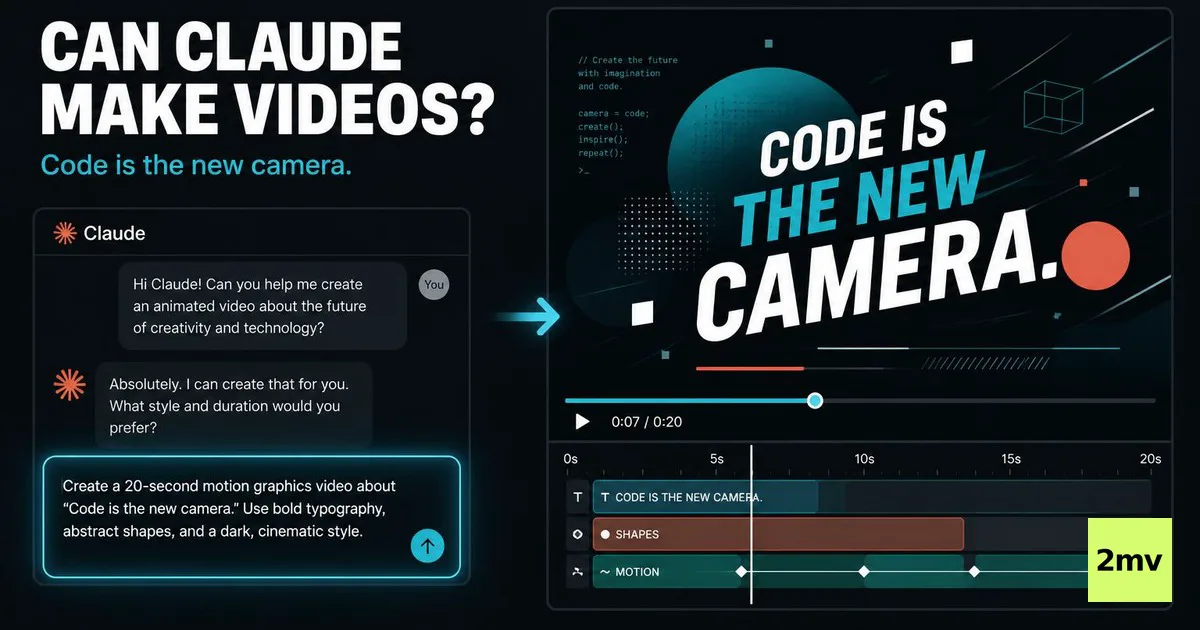
The main path is code as video. You describe an animation to Claude; it writes a self-contained web page — HTML for structure, Canvas and SVG for drawing, Three.js for 3D, GSAP for timing — and that page, opened in a browser, is the video. The list that catalogued the wave states the method in one line: every video in it was made by asking Claude Opus 5.5 to write the animation as code. When you want an MP4 rather than a live page, the tooling is ordinary developer tooling — record the screen, or render headlessly: the wave's breakout music video paints its frames in headless Chrome and encodes them with ffmpeg. Nothing in this pipeline generates pixels from noise. Every frame is the deterministic output of a program, which is why results can be edited at the line level, re-rendered identically forever, and tuned to the frame.
That determinism is the character of the whole path. A text-to-video model samples; a program computes. Typography lands exactly where the stylesheet says. A chart shows precisely the numbers you gave it. A loop closes perfectly because the end state is defined to equal the start state — one line of math, and the video is built for the replay button. When a render is wrong, the fix is a diff, not a re-roll of a slot machine. The trade is equally structural: a program cannot photograph anything, which is a boundary worth pricing honestly later in this article.
The second path is editing, and it runs through MCP — Model Context Protocol, the open standard for connecting models to external tools. A small ecosystem of MCP servers puts Claude in the editor's chair of real software: davinci-resolve-mcp, at 3,237 stars as of late September 2026, drives Blackmagic's DaVinci Resolve; an Adobe Premiere MCP server held 629 stars; kinocut, a lighter cut-down tool, held 177. Through these servers Claude can ingest footage, arrange timelines, execute rough cuts, and run exports — the pixels come from video you already shot, and the model contributes the decisions and the drudgery. It is orchestration of an editor rather than generation of footage, and for teams sitting on archives of raw material it is quietly the more practical half of the story.
One more placement note: the high end of this wave runs through Claude Code, Anthropic's agentic coding tool — the most-starred artifact of the month was built there, with the model planning, briefing sub-agents, and rendering unattended. But the barrier to entry is a prompt, not an engineering team. The list's own instructions are three steps: copy the prompt, paste it into Opus 5.5 — in Claude Code, the Claude app, or any agent running the model — ask for a single HTML file, and record the page if you want a video. That is the entire production stack.
2. The September Wave
The timeline is short enough to state plainly, and every number in it comes from GitHub's API and the projects' public pages as of late September 2026.
Anthropic released Claude Opus 5.5 on September 22, 2026. Within a week, searching GitHub for "claude video" returned 1,690 repositories created since August — each one typically a prompt, a render, and a README. On September 25, a developer under the handle yihui-dev opened awesome-opus5-5-videos, a curated list of the wave's viral videos with the prompt behind each; it gathered 932 stars in its first three days, and by September 29 it held 475 prompt-backed entries, 86 of them added on that single day. A list needs a taxonomy, and the one it settled on is itself evidence: motion graphics, explainers, 3D scenes, and games — of the 100 entries highlighted on its front page, one per distinct prompt, 58 are motion graphics, 16 explainers, 14 3D scenes, and 12 games.
The wave's flagship artifact is PDoomVideo, JohnHeibel's repository holding the source code for "I'm Upping My P(doom)", a full music video about AI-doom odds that Opus 5.5 built in Claude Code. The repository's own account of the build deserves a slow read. The human direction totaled two constraints: use the Clawd character design, and give each lyric interesting visuals and transitions. Everything else — nine chapters, shared character code, a shot-by-shot storyboard — was generated by the model, which also wrote its own animation guide to brief the sub-agents it ran in parallel, painted every frame in p5.js, and rendered the final MP4 through headless Chrome and ffmpeg. The repository crossed 1,520 stars in its first week — for a music video's source code, a number usually associated with developer tooling.
Two properties of this event matter more than its size. First, it is documented: every entry on the list ships the prompt that produced it (or the creator's original post where no prompt was published), which is production-input data that essentially never exists at this scale for viral formats. Second, it is compressed: a format category went from nonexistent to 475 catalogued examples inside seven days. Both properties are what researchers look for in a natural experiment, which is where the fifth section of this article is headed.
3. Why These Videos Went Viral: Decoding the 475
A growth team should not look at this list and ask only "could we make these." The better question is why they spread, because the answer generalizes past this month's model release. Three mechanisms stand out when you decode the distribution — the same breakdown discipline we apply to any short-form corpus, the full manual method being documented in our guide to analyzing a viral video.
The format chose the medium. Fifty-eight of the 100 highlighted entries are motion graphics, and that is not an aesthetic coincidence — it is a census of what code expresses perfectly. Kinetic typography, particle fields, animated charts, morphing geometry: these are native objects of Canvas, SVG, and GSAP, with no uncanny valley to fall into, no physics to get wrong, no hands to grow extra fingers. The wave did not select "video" in the abstract; it flooded into the corner of video where a program is not merely equal to a frame-by-frame animator but stronger. The 16 explainers tell the same story from the knowledge side: an explainer is a script, a chart, and a punchline — precisely a talking document, and Claude has always been a writer of documents. The smaller buckets rhyme too. The 14 3D scenes are Three.js camera moves, and the 12 games are the loop made literal: the video never ends because it is playable.
The hook was the mechanism itself. Watch the audience rather than the videos and the pattern is legible: the comment sections of these posts fill up with one question — "what prompt" — and the list's defining feature, an attached prompt on every entry, exists because replication rather than consumption was the demand. A video that is watchable proof of "a model made this in one shot" carries a built-in curiosity gap, and September's audience was precisely the cohort that rewards it: developers, AI-curious creators, and the kind of person who stars a GitHub repository. That is a niche audience, but a ferociously engaged one, and 932 stars in three days for a plain Markdown list measures the engagement.
A prompt is a template, and templates run on meme mechanics. On TikTok and Reels, a sound is a template: use it and your video inherits the format's distribution while contributing a variation. A prompt works identically — copy it, run it, post your variation — which is why one good prompt spawning dozens of near-siblings across the list reads less like copying and more like a trend format executing itself. Add the loop-native property of code-rendered animation, where a seamless loop is guaranteed by construction rather than edited into existence, and you have short-form's ideal replay vehicle.
PDoomVideo sits at the intersection of all three mechanisms, which is why it anchors the list. Its content is a layered loop: a song about the odds of AI doom, sung and animated by the AI being joked about, in a visual style native to code, aimed at an audience that catches every layer. Its production story — two lines of human direction, a model-written storyboard, sub-agents briefed by the model itself — is shareable proof of mechanism. When a video's subject, its production method, and its audience's identity all point at the same novelty, a week of compounding attention is what you get.
4. What Claude Still Can't Do
An honest account of the wave has to price its boundaries, and they fall into three.
It cannot photograph. The code path renders; it does not shoot. There is no live-action synthesis here — no talking head, no warehouse walkthrough, no product on a real table with real lighting — and the editing path only manipulates footage you already captured. If the video's value is a human face, a physical place, or your actual product in motion, Claude is not the generator for that job, and the wave's own distribution confirms it: the categories are motion graphics, explainers, 3D, and games, and the near-absence of anything photographic is the tell. Google's and OpenAI's ecosystems ship dedicated pixel-generating video models; Anthropic's, as of late September 2026, does not — Claude's route to video runs entirely through code and tool orchestration.
The variance is wide. The same prompt can return a mesmerizing loop or a broken page, and the 475 catalogued videos are survivors — curated from those 1,690 repositories, which are themselves only the attempts someone judged worth publishing. Nothing in this pipeline comes with a quality guarantee; a prompt is a hypothesis you test, not a render button you press. The flagship repo's own history makes the point: it contains two generations, an evaluation of the first, and a regeneration with better internal direction. Teams adopting this path should budget for that iteration loop instead of expecting first-shot output.
And the aesthetic will saturate. This is the pattern-decay dynamic of short-form applied to a new medium: the first hundred kinetic-typography videos bought their reach with novelty; the ten-thousandth will be wallpaper. The wave's formats are already converging on recognizable templates — the particle logo reveal, the animated essay, the playable post — and the differentiation cost of running a saturated device rises exactly as its familiarity does. That is not an argument against the path. It is an argument for entering it the way you enter any trend: early, with a variation, not late with a copy.
5. For Growth Teams: The Research Layer
Here is where this article shifts from product review to the question we actually work on, because for a brand or growth team September's wave is two different events stacked on top of each other.
The visible event is a production shortcut: a cheap, controllable path to a narrow class of videos — kinetic explainers, data-driven motion graphics, loopable brand animations — that previously required a motion-design professional. That matters intensely for some teams and not at all for others, and the table in the next section prices the decision.
The more valuable event is the corpus. Four hundred and seventy-five viral videos, each with the prompt that produced it, dated inside a single week, is research data that essentially never exists for viral formats — normally you reconstruct the inputs after the fact, and here the creators published them. The work that converts that corpus into strategy is decoding: which devices repeat, which are already saturating, which videos are outliers against their creator's baseline versus the genre's average, and what a brand's variation would need to read as a contribution rather than a copy. That is the Watch-and-Decode half of the five-engine system we run — the approach is sketched in what is 2mv — and the practitioner's version of the method is the manual breakdown linked above.
One honesty note on scope, because we hold ourselves to it with every tool we review: our own analyzer serves short-form social video. The AI video analyzer is built for TikTok, Reels, and Shorts links: per the product's description on its own site, it returns an eight-axis breakdown — hook, structure, content flow, visuals, audio, viewer psychology, audience profile, topic — plus a beat map and timing guidance. The Opus wave lives on X, GitHub, and Skillry rather than on those platforms, so the ingest does not transfer; the decode method does. And what transfers furthest is the comparative layer, because 475 videos is too many to watch honestly and too valuable to sample blindly — the same one-video-versus-a-corpus distinction that runs through this series.
6. Matching the Tool to the Task
The decision has the same shape as the one in this series' companion pieces, but inverted: there the question was which assistant should watch your videos; here it is which system should make them. The waste in both directions is always a mismatch between the job and the tool class.
| The video you need | The right-class tool | Why it wins |
|---|---|---|
| A motion-graphics piece, explainer, or brand animation | Claude, code path | Deterministic render, line-level edits, loops by construction |
| An ambitious concept piece or music video | Claude Code plus your track | The PDoomVideo pattern: model-written storyboard, sub-agents, headless render |
| Re-cutting footage you already shot | Claude via an MCP editing server | It drives Resolve or Premiere; the pixels stay yours |
| Live-action you have not shot yet | A generation model, or a camera | Claude renders; it does not photograph |
| Knowing why a niche's videos are working | Research tooling | Baselines, pattern counts, saturation estimates — one prompt cannot see a corpus |
The bottom row is the permanent one, because it is the only job that compounds: this month's production trick decays, but knowing why formats win is an asset that appreciates. On the watching side of the fence, the trade-offs are covered in can ChatGPT analyze videos and can Gemini analyze videos — Claude, for its part, documents vision over images but no native video input as of late September 2026, which is exactly why its video story lives on the making side. Use it to render what code can render; use research tooling to know whether what you rendered is worth posting.
7. Conclusion
Can Claude make videos? As of late September 2026 the answer is yes, with an asterisk that is the interesting part: it makes them as code, the way a developer makes software, and the September wave — 1,690 new repositories, a 475-entry prompt-backed list, a music video repository with 1,520 stars — demonstrated both how far that path reaches and where it stops. Within motion graphics, explainers, 3D scenes, and games, it is now a genuine production route: cheap, controllable, and editable at the level of source. Anywhere a video needs photographed reality or a guaranteed outcome, it is the wrong instrument, and the honest reading of the 475 is not "this is easy" but "these are what survived." For growth teams the production question is secondary anyway. The lasting artifact of the week is a public corpus of viral videos with their inputs attached — and the teams that decode it will out-position the teams that merely copy it.
FAQ
Can Claude make videos like Gemini?
Only in the sense that both end with a file you can post. Google's ecosystem ships dedicated text-to-video models that synthesize pixels from a prompt; Anthropic's does not — Claude's videos are programs it writes, rendered deterministically. If your comparison is really about analyzing video rather than making it, that is Gemini's home turf, and we cover it in can Gemini analyze videos.
Can Claude make videos from images?
Yes, within the code path — images become assets that the generated code animates. The wave's list tags several entries "AI image," meaning the creator generated stills with another model and had Claude build the motion around them, and that hybrid is emerging as a practical pattern: generated frames for look, code for movement.
Is making videos with Claude free?
There is no per-video cost in the code path. The prompts on the list are public, rendering happens in your own browser or with open-source tooling, and the only meter running is whatever Claude plan you already pay for. The editing track carries its own economics: the MCP servers are open source, but the editing software is not necessarily free — Resolve's free tier and Premiere's subscription are separate line items.
Can Claude edit my existing videos?
Yes, with caveats. MCP servers let Claude drive professional editors — davinci-resolve-mcp at 3,237 stars, an Adobe Premiere server at 629, and kinocut at 177 as of late September 2026 — so it can ingest footage, arrange timelines, execute rough cuts, and export. Treat it as an assistant in the edit bay: the mechanical work accelerates, while judgment on the final cut still benefits from a human.
What kinds of videos does Claude make best?
The distribution answers directly: motion graphics dominate — 58 of the 100 highlighted entries on the wave's list — followed by explainers, 3D scenes, and playable games. The worst fit is anything live-action. If the concept is typographic, diagrammatic, or geometric, code is an ideal medium; if it needs a face or a place, it needs a camera or a generation model. For the actual workflow — from picking a format family to rendering the export — our how to make videos with Claude guide walks the full loop.
Why do so many Claude videos look the same?
Because a prompt is a template, and templates converge. The 475 catalogued videos are curated survivors of a much larger pile, most of them variations on a modest number of prompts — and on short-form platforms, a repeated format decays into wallpaper precisely as its recognition rises. The wave's own numbers reward the early variation, not the late copy; that is pattern decay, and no model release repeals it.
Can Claude make videos · published 2026-09-30 · 2mv Team